When you read the title, you may think of the popular book of the same name by author Shel Silverstein. Though I will say that the similarity lies in the act of creativity and the joyful lessons children bring if we allow ourselves to see through the busy clutter of everyday life. The inspiration for this reflection, however, came from a morning walk with my two nephews.
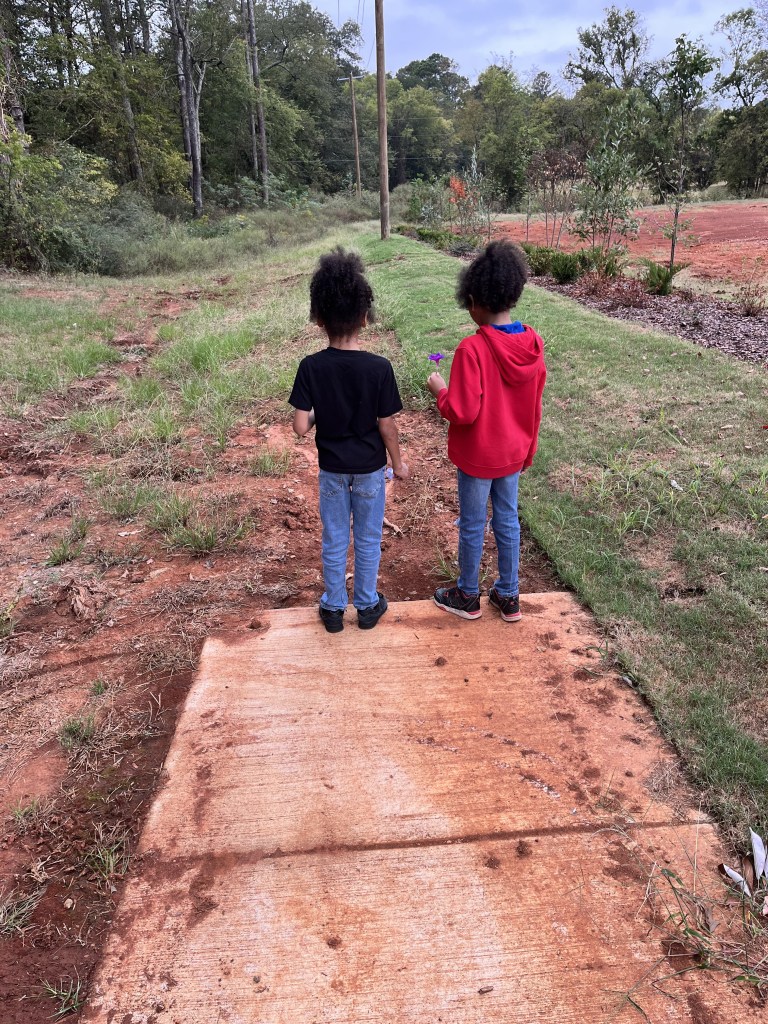
We were making our way down the sidewalk in a newly constructed neighborhood when just over a hill we came to the actual end of the sidewalk. At that point I had them to stop. Not because we were tired or had run out of places to go, but because the sidewalk simply was no more. Now mind you, they wanted to keep walking, mud and all. What happened next was a classic act of life opening up to reveal the prize inside. Although I told them to stop, their imaginations kicked in and took them offroad instantly.
They began discussing what might happen next as they teetered on the edge of the concrete like it was some mile high ledge, moving from serious to uncontrollable giggles and back again. Their conversation took on a life of its own. There were no maps, no predetermined destinations, and certainly no concern about whether the path ahead had been properly paved or explored. They were simply entertaining possibilities. Ever the observer, I watched and thought about how differently we tend to approach these moments as adults. When a familiar path ends, we often see it as a setback, a disappointment, or even a failure, scrambling to get back on the set path even when it takes us in circles. We become so accustomed to the way things have always been that we sometimes mistake the end of a particular route for the end of the journey itself. I’m here to inform you that it’s not.
What if the end of the sidewalk is an invitation rather than an obstacle? An opportunity to reconsider our direction, imagine something different, and perhaps discover that we are better suited to thrive in an environment we have yet to explore or entertain. There is something particularly relevant about that thought in this social climate we find ourselves navigating. Perhaps some of the structures, assumptions, and familiar pathways we’ve relied upon deserve another look. Maybe the answer isn’t always to fight to keep the sidewalk going in the same direction. Maybe it’s time to consider where else we might walk, swim, or even fly. Let’s remove the imposed limitations. They may not be serving us to our full capacity
Children haven’t yet learned all the reasons why something can’t or should not be done. They haven’t accumulated quite as many invisible fences around their thought processes. They see an ending and instantly begin imagining what comes next. I have a close friend like who is always open to the possibilities, encouraging me to step into unfamiliar territory. To experience something different, you’ve got to do something different. He’s a visionary and entrepreneur living in childlike faith and godlike ingenuity. He see it in his mind and brings it to pass with laughter and excitement. Believe it or not, that’s contagious. I appreciate that because it helps me to go beyond myself, therefore expand myself. Perhaps we could all stand to do a little more of that. So, the next time you find yourself at the end of a familiar sidewalk or situation, maybe don’t be too quick to turn around and go back the way you came. Take a moment. Look beyond the concrete. There may be an entirely different landscape … or life waiting just beyond it.