We Are The Monuments…

We’ve all, at some point, walked past monuments built by others, honoring others. Why do we wait for someone else to honor our stories? What happens when we realize we are the monuments, the living, breathing proof of endurance, imagination, and grace? Our buildings aren’t just brick mortar, and glass. Our art is never just paint on a surface. They are evidence of belief and resolve that refused to fade. It’s the kind of creation that reminds us our presence is the monument, our work the foundation, and our progress the pedestal upon which our future stands.

Some Wise Dude


About a year or ago I got a call from a fella, telling me he needed a mural done on the FX Market on Pulaski Pike. Now, mind you, I used to get a lot of spam calls like that. So much so that I was advised to remove my phone number from my contact information. The gentleman on the other end was Vincent E Ford, serial entrepreneur working on a plethora of projects. He said he’d tried to reach me two years prior. We set a meeting and went from there. At our first meeting, I felt I knew him from somewhere. He tuned in to the familiarity, so we started climbing the family tree.  We did have some people in common but only by marriage. I came to know that he had a construction company, a flagging company, some housing developments, an event center in the works, and one other FX Market gas station before the one upon which he wanted the mural painted. For some reason, it didn’t take long for us to begin bantering like we were old friends. 

When he came through on the mural and shared his why, I felt better about the project. The subject matter was The Buffalo Soldiers, the U S 10th Cavalry Regiment that had camped on a hill near the FX Market site in the late 1800s because they were not allowed to stay with the white soldiers.  At first the idea of painting this on a gas station didn’t thrill me. After some consideration. I came to realize it was the best place. Besides, I’d already activated the land long before I knew who was doing something with it when I had exhumed red clay from the site.  This was people’s art and all types of people patronize gas stations. It wasn’t just about painting on a gas station, it’s creating legacy in so many ways. And this isn’t just a gas station; it’s a monument honoring monuments.

In the 1960s, according to local historians, there were at least four Black owned gas stations in the Huntsville/Madison County area. Currently, according to one study there are only four in the entire state of Alabama. Two are here in Huntsville/Madison County and Vincent Ford is the proprietor of them both. He had an idea, dreamed it up, and brought it to pass. At the end of the day, we all need gasoline, right. The first one he built is on family land in Harvest.  The other one (with the Buffalo Soldier mural) sits on Pulaski Pike across the street from Northwoods Public Housing Community where he grew up, and the namesake Historic Space after the Buffalo Soldiers, Cavalry Hill. It stands as a testament to belief beyond borders, and attitude determining altitude. What started as a request for paint on a wall between us became something bigger, a mirror held up to what’s possible when vision meets purpose. His gas stations aren’t just a business; they are a declaration that our stories belong in full color, on our own walls, in our own neighborhoods. A gentleman stopped and inquired about the FX Market gas station one day. He had heard it was Black owned. I affirmed. He smiled as he pulled off and said on repeat, “We comin’ up.” I felt his sense of pride and resolve echoed in the declaration. So if you’re reading this and haven’t gone by. Do so if for no one else but yourself. This is an investment in us. When we see what we can do, it gives us the inspiration to continue to do.

This is what happens when belief outlives circumstance. When we stop aiming for the idea of Black excellence and start setting the reality of a Black standard, where ownership, craftsmanship, and community care are the norm, not the exception. When we build, we build for generations to come. When we create, we create capacity. And when we pour into our own, the return is legacy. That mural isn’t just about art in public space. It’s about arrival. A reminder that we don’t just dream beyond our address, we redefine it.

Esperanza

  It was 2014,  on the eve of my hearing of the passing of the legendary luminary Maya Angelou that I penned these words held buoyant by hers, “Bringing the gifts that my ancestors gave, I am the dream and the hope of the slave.”  For the last few weeks I’d walked in the challenge of addressing, through art, the theme of violence in Colombia.   Colombia was enslaved by a history of violence that continues to taint its present color in the eyes of the rest of the world.  In my time there, from speaking on the panel with the mayor of Medellin downtown at the Mayo por la Vida Celebration, to walking the neighborhood streets of rural Apartado with school age children; I saw the power of the very thing that Maya Angelou talked about-hope.  Hope, not the one that sits and reaches out to nothing and just waits. No. Hope, that unsinkable mindset that hovered above me night after night as I pondered the depth of the question asked of me many times during my sojourn there, “Do you really believe in world peace?” Each time, the question hit me like a dark wave threatening to drown the belief in change to which I clung ever so tightly.  

   One evening I had the honor of visiting a three year old girl who had been shot just days before.  As I knelt down beside her, without hesitation or concern she reached out and put her tiny arms around my neck and gave me a hug that could have embraced the world. In her sunshine smile and angelic eyes I saw what I needed to see, my answer, the reason I was doing what I was doing.  I saw hope in its purest form shining onto my faith and casting away any shadow of doubt that may have been lurking in my mind. Not the type of hope that sits waiting, internally pleading for something to change, but the kind that continually rises up in the face of all that would suppress us.  The Spanish word for hope is esperanza. That little crippled girl awakened in me a renewed sense of hope.  Esperanza was echoed in the face of every child and Colombian I saw from that point onward. I always reminded myself that there’s always a way.

  I am an artist, and art is my weapon of choice for peace and justice. What I mean by justice is that which I want for myself, I also want for others. I bring, like Maya Angelou said, the gifts the ancestors gave and I use them for the enriching of this planet we are blessed to inhabit.  Although I was a speaker of English in a Spanish speaking country, art is a universal language, and her most vivid color is love. I was met with the spirit I came with. I walk with art as agency for change. Change is coming. Not only do I believe it, I know it because I saw the preview of a new world reflected in the eyes of the children who looked into mine. And in their smiles and attitudes I saw the blueprints. That isn’t political or scientific, or any other form of measurable statistic.  It’s the power of esperanza. Where there is life, esperanza (hope) lives, and where she lives, change is inevitable. Hold on.

Hills of Dreams: Becoming What We Needed to See

Sometimes the universe whispers before it speaks.

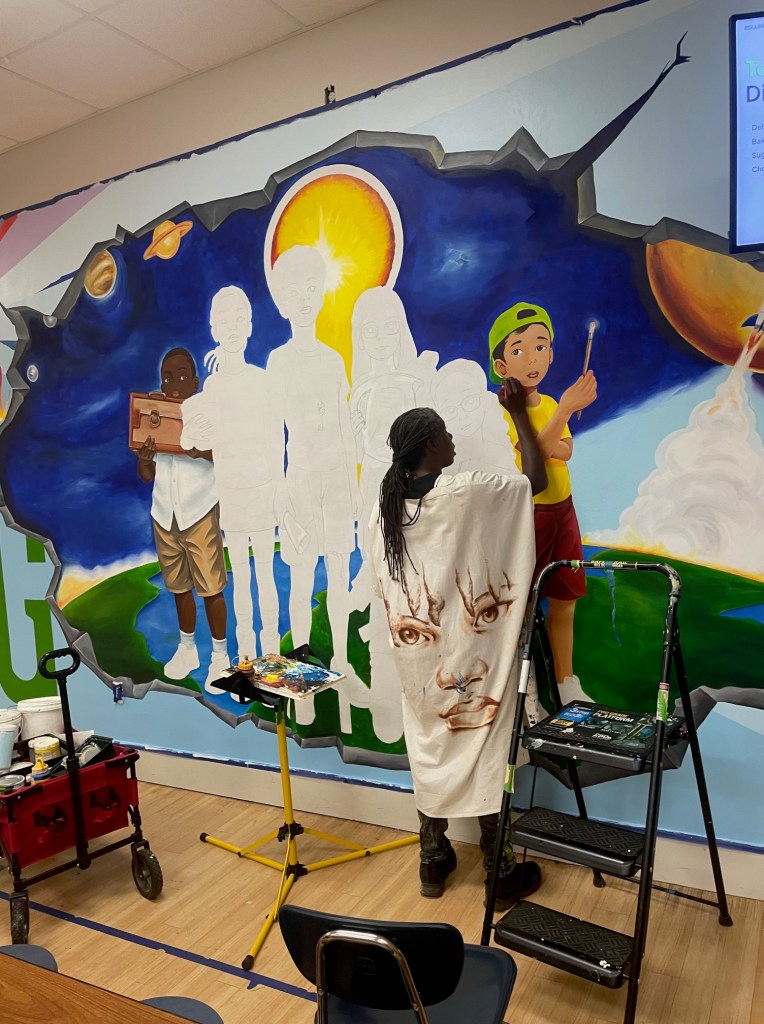
Not long ago, I had the idea that I wanted to do something for the elementary school I attended as a child. I considered doing a mural or workshop. It was an idea that I mentioned only to my wife and scribbled in my journal. The very next week, no joke, I opened an email from the art teacher at Rolling Hills Elementary School. Her enthusiasm came straight up outta that computer. She had seen my work and wanted me to paint a mural. She had the will and the zeal, but no true idea what it would take or cost to bring it to pass. But I already knew it was destined to be. We trusted the process. Huntsville City Schools and local sponsors answered the call and the project was set in motion. We would call the mural, Hills of Dreams.

With mixed feelings I returned to those linoleum floored cinderblock halls where my own journey began. Rolling Hills Elementary School was where I first discovered the joy of art making as a thing, the exhilaration of diving deep into the creative process, seeing my work on the walls for the very first time. Where I walked with reverence into that precious carpeted library that served as a keyhole to the worlds of my interests. Where I watched a popcorn seed planted in a baby food jar sitting in the window, sprout and reach for the sun. Where at the end of my fourth grade year, the teacher gave me my pick of books on the shelf by her desk. I felt like I bit off a little piece of heaven that day. At that little cozy elementary school tucked into northwest Huntsville, nestled on a hilltop, the foundation who I am as a creative was laid. To create there again, among students and teachers, was more than full circle. It was cosmic alignment.

One day, while I worked on the mural in the cafeteria, a group of students came in to watch a film. Out of curiosity, I glanced back at the screen then noticed a boy with his face toward me. He wasn’t watching the movie at all. His eyes were fixed on me as I painted. I could feel him watching. Deep, steady, unblinking. I turned back to my work, brushed paint onto the wall, and later looked again. He was still watching. Still locked in. Of course it didn’t bother me at all. People always ask whether it distracts me when they watch or talk to me when I am painting murals. The answer is no because I see mural painting as a type of performance art. Interaction with the audience is an integral part of the work.

In that moment, I wondered What was that little fella thinking? Was he seeing himself in me? Was I looking back at me at that age? I thought about how vital it is to live fully in my space, to be visibly present on my wings. Because oh, what it would have meant for me to have seen that when I was his age. To see possibility embodied, to see someone creating, to see myself reflected in real time. That’s what doing what I do is about. It isn’t just putting paint on walls or pen to paper. It’s about planting visions. It’s about representing and recreating for inspiration. It’s about adopting the responsibility to be what I once needed to see.

Every child deserves a light to reach toward. Adults can use it as well. So what do you say we commit or recommit to standing tall in our space, to showing up fully, to inspiring boldly for the ones watching us with wide eyes, waiting for their own wings to sprout. Because Hills of Dreams is not just my slinging paint on a lunchroom wall. It’s an embodiment, an incubator for what belongs to every child or person with a dream bigger than their circumstances. It’s for all of us who dare to go for the dream and to forge trails for others to follow. In fact , as I consider it all, I think I’ve been dreaming too small.

Rest, Don’t Quit

Last week, I got up every day well before sunrise and kicked in with all eight barrels wide open and didn’t leave the studio until long after that ole sun had dipped below the horizon. For the last few months, large overlapping projects, no breath in between. No real pause. Just that headlong push— the kind, I admit a part of me relishes, leaning into the body temple like it’s an infinite source of fuel. Please note: even the most well built temple can crumble if it’s not respected. And truth be told, I’ve been known to test the limits of this vessel far too many times. Not out of recklessness—but out of love for the work, out of fire for the vision, and sometimes, if I’m honest, out of a lurking fear that if I stop, something might slip away.

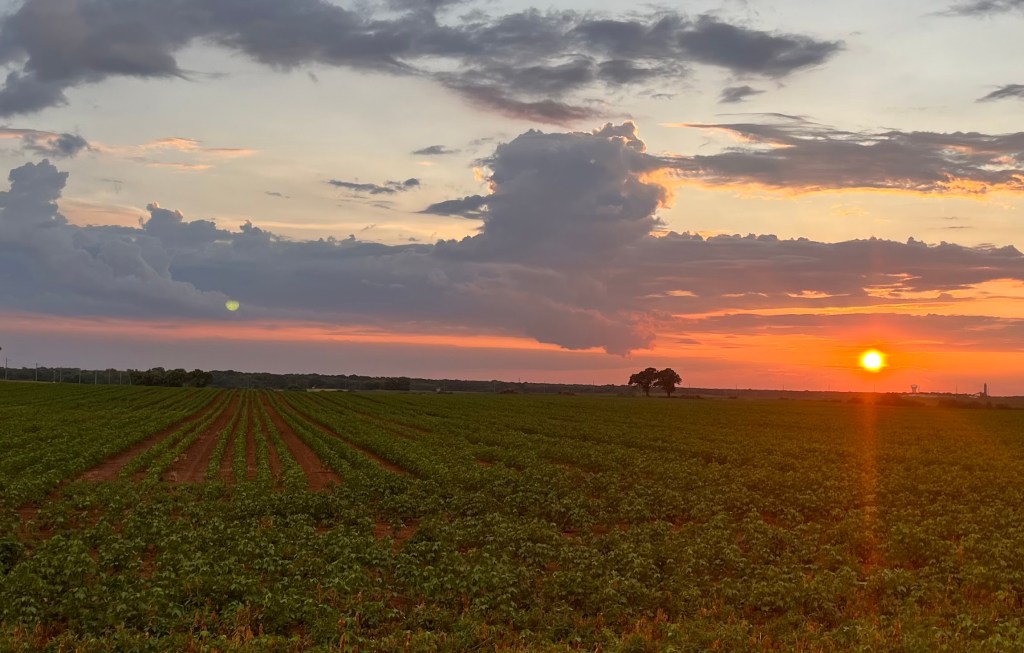
Despite rapper and entrepreneur 50 cent’s declaration “Get Rich Or Die Trying”, pursuing your purpose shouldn’t have to kill you. Even the sun goes down. There’s a lesson the great orb in the heavens teaches every evening if we’re still enough to notice. That golden glow of descension isn’t a sign of quitting—it’s a sacred cue to transition. A reminder that even light knows when to rest. That beauty doesn’t just live in the blaze of midday hustle—but in the hush, the slow fade, the surrender, the rest.

Yet we so often glorify the grind (I’m not totally against it), wear exhaustion like a badge, and limp with a smirking pride. What if rest isn’t the enemy of progress—but its partner? What if stepping back now and then is how you step forward with intention? What if your goals need your soul to be whole and rested to rise? I’m learning continuously, even now, that discipline isn’t just about how hard we push. It’s really not so much about how fast or furious we plant, but how deliberate. Even then, we have to wait for the increase. It’s about knowing when to pause. Not to quit, but recalibrating. Not burning out, but burning slow and steady so the flame lasts. So this is me, telling myself and sharing with anybody else who needs to hear it. When the sun sets, let it be a cue. Let the studio close. Shut it down. Let the body breathe. Let the mind drift. Let the spirit sit in its quiet strength. It’s ok to rest. Just don’t quit.

This Is It

As I am writing this I hear the echo of DMX’s gravely bass growling, “Lord gimme a sign.” In the same song he says. “No weapon formed against me shall prosper/And every tongue that rises against me in judgment, thou shall condemn.” This is a truth I hold to be self evident and I invite you to do the same. At some point in our journey we’ve found our weight unusually heavy. Our path gets overshadowed and the way blurs in front of us. In those times we’ve asked for some word, some clue, some sign to let us know what to do or where to go from here.

Allow me to share a short fable about a great oak tree that grew strong on the edge of a cliff. Its roots gripped the rocky ledge. The tree was battered day after day by windstorms, rain, and scorching sun. Every other tree in the softer soil of the valley grew faster, looked fuller, and seemed more secure. But when the storms came, those trees were the first to feel the brunt of the winds and rain. They fell. The oak held firm. Why? Because it had been tested. Every storm, every gust of wind, or shudder of the earth had made it dig deeper, reach further, and grow stronger. It didn’t just survive the storm—it was shaped by it. That oak is us.

Right now we’re living in a time where many feel they can’t go on like this. True the weight of uncertainty can feel real. But please be reminded that deep down inside is a place within us that is always certain. The winds of change are howling and it’s easy to wonder if we’ll make it through, if we’ll get by. But there’s a part of us that knows we will. I want to remind you of this as well: trouble don’t last always. And more than that, it doesn’t get the final word. In fact, it’s often in the pressure—the pushing, the waiting, the stretching, the longing —that the best in us rises. We discover grit and grind; we didn’t know we had. We learn to dig deeper, think sharper, love harder, and spread hope wider. We were made for this.

When the going gets tough, we don’t just endure—we evolve. We double down. We link arms with those who are on journey with us. We get creative. We hustle. We pray. We build. We were never meant to fold—we forge. This opposition is not the end. It’s the sharpening stone. It’s what is going to make us shine all the more bright. Hold on. This moment is not the breaking point—it’s the turning point. We will win—not because it’s easy, but because it’s in us to do. We have a power that cannot fail. Hold on. Hang in. Push forward. This storm isn’t here to take us under. It’s here to reveal us. If you’ve been waiting for a word or a sign. This is it…

…Where The Light Ends

When I was a boy, my cousin—who also happened to be my best friend—moved into the neighborhood just behind ours. It was like a dream come true. It wasn’t right behind us like the next yard. We weren’t connected by roads, but by a stretch of woods, a washed-out creek, and a decaying bridge with only the hulking metal beams left. There were no streetlights. No sidewalks. Just, trees, grass, earth, and shadows. Between our houses was a journey, not a route. And that journey taught me more than I realized at the time.

One fall evening —one of those days where the trees are close to bare and the air feels thin, not quite cool but southern chilly—we were hanging with some of the guys in my friend’s neighborhood near their house. We were pulling dried stalks from their dad’s garden area and hurling them at each other like spears. We were laughing children at war with boredom and boundaries. The sun had since began its slow descent, and after a while I felt that familiar tug: You need to go now….soon. It’s going to get really dark. And soon enough, it did.

As artists and creatives, we know that moment well—the sinking light, the encroaching unknown. The moment where playtime ends or procrastinations needs to, and the solitary path begins. I had asked earlier when the sun was high, would they walk me home through the woods if I stayed longer. They said they would if I stayed. I took assurance in their words, plus I wanted to stay anyway. But time kept slipping by, and it finally became clear when the excuses started, that none of those guys were taking that trip with me. I looked in the direction of home. The space between the trees was a gaping dark hole, daring me to enter. Finally, in a moment of clarity, decision, and being fed up, I grabbed a handful of rocks—my version of protection —and headed on out, stepping into the woods all by myself.

Years later, I see that boy in so many of us. The ones with vision. The ones with stories lodged beneath their skin and colors in their souls. The ones who stand at the edge of the metaphorical woods, waiting for someone to walk them through the dark patch. Waiting for the invitation, the validation, the right mood, the funding, the perfect collaborators, the clean studio, the ideal conditions. But the truth is, the work begins where the light ends. The art, the creativity, the work, waits in the dark.

The truth is, we’ve all stood in that backyard at some point in our lives, playing around— then wanting, waiting for someone to walk us through the hard parts. Waiting for the timing to feel just. Waiting for the fear to shrink or for company to show up. Sometimes people mean well. Sometimes they don’t come though. Sometimes they can’t. And sometimes, the path you’re supposed to take is meant to be walked alone. You don’t need a full spotlight or a crowd of supporters. Sometimes all you’ve got is all you’ve got. Summon the courage to start. Sometimes you walk with shaking knees and pockets full of rocks. But you go anyway.

There are times in this creative life—heck, in any life—when you’ll need to go through the dark time alone (but are we really alone?). Not because no one loves you or believes in you. But because it’s your walk to take. Your vision to carry. Your bridge to cross. This is for the ones who are waiting. Waiting for someone to walk with you. Waiting for the right moment. Waiting for the perfect conditions. Waiting for a word from the Lord. Strongly consider moving past the wait because many people have gotten stuck right there and spent the rest of their lives telling stories of how they coulda shoulda woulda…That’s not you.

Grab your rocks. Use what you have . The path may be shadowed, but your gift was never meant to wait for perfect light or time. It was meant to create it. Go ahead and take that next step, even if it first leads you into the shadows and a season of silence. And when you do—tired, uncertain, carrying only what’s in your hands and heart—you will emerge not necessarily into applause, but into truth. Into the space you were always headed for.

Now

The other day my daughter sent me a photo of a cicada having just emerged from its shell. The shell or husk of this singing creature we call in the south, July Fly, is called the exuviae. I admit that as much as I love nature, that was new news to me. Exuviae seems like such a grand title for something to be left behind. As a boy, I would invest some precious time gathering these exuviae for various lofty purposes. One of them being placing them in strategic places (like on the collars of shirts) to scare the heck out of my sisters and their friends. In the photo, the new olive green, black splatterred cicada is perched a slight distance away from its exuviae. It was still stuck to the side of the porch, looking like a relic from a past self. And there was its former content, the cicada itself; raw, fresh, and very much alive. What struck me most was the timing. It’s pretty early for it to be out. Too early, maybe. The others haven’t arrived yet. The trees aren’t humming with that familiar chorus that signals summers arrival. And yet—this cicada was already here…now.

That moment held a mirror to the creative life. We are, many of us, called to emerge before it’s comfortable. To come forth and close the gap between the present and later. To break open, transform, and show up even when the timing feels off or the world doesn’t seem ready for what we have to offer. Maybe especially then it’s more important. Living a creative life—especially in times like these—can feel like crawling out of a shell when no one else is watching or exposing yourself to the harsh elements of life too soon. You may wonder if you’ve misread the signs. If you’re out here alone. If the world will catch up or just keep turning without noticing… or fully reject the you that you really are.

Here’s the truth the cicada whispered to me: Transformation doesn’t wait for perfect timing or a set date. It happens when it’s ready. Oftentimes even before you feel you are ready. And readiness doesn’t always look like safety or certainty. Sometimes it looks like being the only one brave enough to show up and shine in your truest form. As artists, thinkers, makers, dreamers—we don’t always get the chorus or even a go for it. Sometimes we just get the barely heard whisper to begin.

So today, let this be your sign: It’s okay to emerge. To come out and be who you really are and do what you do. Even if it seems too early. Even if your world seems quiet. Your creative life is not tied to the crowd or the calendar. It’s tied to the truth inside you, pulsing with its own rhythm, knowing when it’s time to break open. You hid long enough within the shell that may have protected you, but it’s no longer who you are now. Step out. Create, write, speak, plan, sing, build, sign up. Become luminous and let your light shine without apology. Leave that exuviae behind. Be here now. The world will not only adjust to you, it needs you – the real you.

Reflection

I was recently painting a mural at an elementary school when the most inspiring thing happened. Not that inspiration isn’t flowing freely in an elementary school anyway. It was one of the last few days of the school year and energy was over the top. And boy do I remember those days. Plus it was a delayed day because of a previous night storm. A small group of teachers gathered in the Lunchroom for movie time for the children. Kindergarten through third grade piled in and planted themselves on the round stools at the tables, their attention supposedly glued to the big screen. Every so often, I’d pause from the strokes of my brush amid giggles and squeals, and glance back at the group and the show they were watching. Each time, I noticed one particular little fella—not watching the movie like the others—but watching me with intensity. Quiet. Still. Eyes locked in on my process.

He didn’t seem restless or antsy but focused. It wasn’t like he was distracted from the movie. I don’t think he had even started watching it. He was drawn—not to noise or the movie screen, but to the motion of my brush, the forming of images, The colors spreading on the wall, the unfolding progress of creation. To me, it was doing the thing I do. But to him it appeared to me magnetic. I couldn’t help but wonder what was going through his little head. Maybe he was in awe, mesmerized by this art thing. Maybe he saw himself. Maybe he recognized something familiar in the rhythm of the interplay of mind, spirit, passion, and whatever else makes us do what we do when we do it well. Maybe he thought I looked funny. But more than anything, what I realized is this: that used to be me, often silent but fiercely observant. Sometimes, the quietest gaze holds the loudest affirmation.

As a boy, I was captivated by the act of making, how things came to be. The why, who, when, where of the what. It drew me like a plant pulled toward the sunlight. I didn’t always have the language for it, but I knew I knew. There was something calling, beckoning. And now, all these years later, I find myself on the other side of that moment, being watched by a child whose heart might be whispering the same call. It reminded me that the work we do—especially the work born from intention, from purpose, from struggle and joy—echoes from the depths of life to the surface. It creates ripples. It becomes a mirror, a map, or a magnet for someone else.

That’s why it is imperative that we keep showing up. Not just for ourselves, but for the ones quietly watching, absorbing, being shaped by the vision of what’s possible. We are giving permission to the next artist. The next teacher. The next leader. The next dreamer. The next builder of worlds. What matters most doesn’t just leave a mark on walls, paper, stage, or film, —it leaves a reflection for and in those to come.

Photo by Michelle McClintock

It Is What It Is

There’s something about standing in the cool shadow of death that reminds us to live. Not just to exist. Not just to breathe. But to live.

Recently, my aunt passed on. I stood beside her as we talked possibly more than we had ever talked before. At least one on one like that. Other times we had always been surrounded by other family members as we exchanged a few words here and there. In that still room, a holy hush wrapped itself around us. I looked down at her—and I saw her. Not as I had always seen her—but as she truly was. Her full lips. Her smooth, unlined skin. Her deep, brown eyes, wide listening. It felt like I was seeing her for the first time. I saw her almost perfect hands were manicured with no polish, barely warm as they wrapped around mine. I heard my Dad’s words come out of my mouth, “I want to pray with you.” When I finished, she continued in a whisper barely audible. Then she smiled.

She was not an old woman. Not by our measure. But here she was resting in that portal, that liminal space between breath and spirit, between what was and what will be. She spoke in whispers, each word labored, each syllable soaked in meaning. Then came the moment that now echoes in my soul. She took a deep breath—one of her last for the week—and as it left her lungs, it came forth with
“It is what it is.” At first, I thought it was just a form of resignation. It felt like so much more though. It was revelation. For me, one who values spiritual connection and ancestral knowing, that phrase carries weight. It isn’t about giving up. It’s about giving in—to divine order, to ancestral timing, to the eternal rhythm of life, death, and rebirth. “It is what it is” is not a shrug. It’s a knowing. It’s a surrender that comes with dignity. It’s the utterance of one who has come face to face with the edge of this world and has decided to speak peace to it.

In our communities, we often mask our pain with strength, with a fake stoicism. But there’s something radical about embracing what is. It is an act of spiritual resistance. A return to the old ways of being in relationship with the mystery. To look death in the eye, and still bless the moment with your breath! That is power. That is ancestral poise.


To her two sons—my cousins, no longer the little boys I remember running around—I want to say this: Your mother loved you with an undying love. She saw you. She knew you were and as you are. It’s is in your hands now to take that to the next level and be the best seeds she ever planted. make good on her investment. She carried you, not just in her womb but in her spirit. She watched over you with quiet strength — and she could let loose with some fire to get you in gear. We know she didn’t play. None of us are angelic all the time. Some of her final words to my ears, “It is what it is,” were not meant to harden or dismiss—but to hold us. She was teaching her final lesson. That life cannot always be understood, but it must always be honored. That even in the transition, there is truth and knowing that goes forever forward. That we don’t have to make sense of everything to be at peace with it. Let those words become your shield. Let them remind you that what goes away has not vanished, only changed form. That smile, that laugh of hers is still with us. Your mother is an ancestor now, an ascendant. She is not silent. She is speaking still, through memory, through love, through you.


To those who have loved and feel the loss—You are not alone. Our people have been burying loved ones for generations, and still we rise. Still we sing. Still we embrace and smile at each other at funerals, calling joy out of sorrow. The dull ache of grief may never leave you. But neither will the love. Love never dies. Stand up straight in the cool shadow of death—and allow it to remind you to live. To laugh. To cry. To say “it is what it is,” not with defeat in your heart, but with reverence on your lips. Those words to me, in that moment from my aunt, were a benediction. A battle cry. A blessing.

More Than a Portrait

It was more than an honor to play a part in the resurrection of Jefferson Davis Jackson’s image and legacy. From the very first mention of this project, I sensed it was more than an artistic endeavor — it was a cosmic assignment, a sacred agreement between the seen and unseen, calling forth the spirit of a great man long buried beneath the weight of history’s silence. For 66 years beginning in the late 1800s, Jefferson Davis Jackson worked on the University of Alabama campus beginning at the tender age of 11 years old. Many of those years he labored alongside Dr. Eugene A. Smith, a professor and geologist invested in finding the natural resources that could be used to develop industry in the state following the ravages of the civil war. Jefferson Davis Jackson, a man devoted to life, wore many hats on campus and abroad. From custodial, to maintenance, to traveling by horse and buggy with Dr. Smith across the entirety of Alabama excavating and documenting the natural resources and history of the state.  From home to church, to work, he was all in. He worked in the very building, Smith Hall, where Autherine Lucy, the University of Alabama’s first Black student took classes. Was he there the day a shotgun blast blew a permanent scar to the outside of Smith Hall, or the day an Alabama governor made a diabolical declaration.  Somewhere along the way the name and legacy of J. D. Jackson were covered over by time, ignorance, and the order of the day. 

One day I received an email from a young woman working in the Museum of Natural science at the University of Alabama. It’s Alabama’s oldest natural science museum. I could feel the excitement through her appeal.  She had found a trail leading to the greatness of a Black man Named Jefferson Davis Jackson. She wanted me to do a red clay portrait of him. “I knew I had to contact you.” she said. “I knew you were the only one who could do this justice.”  Soon we spoke by phone and, feeling the tug of ancestral beckoning through my busy schedule, I agreed to do the portrait. I needed to walk the areas he walked, see the spaces he inhabited, speak to relatives, and gather earth from his walked pathways. Why did he start working at the university at age 11? How did he lose his eye? We scheduled a trip to Tuscaloosa and the journey began.

The process itself is ritual. I gathered red clay from the very soil of the campus of the University of Alabama. This time under the click of cameras and the gaze of assistants. The sacred ground is alive with memory, connecting my work to the land and its complex, often untold, narratives. The red clay, stained with the life-blood of our ancestors, holds within it both trauma and triumph — the iron-rich soil echoing the iron in human blood, linking us inextricably to those who came before. In its crimson grains, I feel the pulse of generations. Mother Earth knows their names. The clay is a portal, a living map. To this I added water from the nearby Warrior River. Water represents spirit. The river is a witness, a keeper of stories, a carrier of forgotten songs. Its waters hold the essence of what was lost and what still lingers. As clay and water met paper, each touch was more than technique. It was an invocation. The act of placing clay upon the surface became a merging of worlds, a thin place where past, present, and future blurred. I never work alone. Sometimes I feel like the ancestors are leaning in, guiding my hands, speaking through the vibration of the red earth. In this work Jefferson Davis Jackson was not just being rendered, but reawakened, his light called forth through the elements of earth and water, through the breath of spirit and artistic calling. 

The portrait is a vessel — a bridge between dust and flesh, blood and starlight, past and future. The red clay tethers this work to this southern landscape and to the heavens. It affirms what we already know deep in our bones: that our stories cannot be erased. They may sleep beneath the soil, but they rise again through us, with us radiant and undeniable. In this artwork, Jackson stands not as a rendering or shadow of the past but as a resurrected star in the firmament of Black excellence, human nobility, a beacon for those yet to come. From his devotion to the university and his community to his baritone voice in the church choir, he was a man among men. This is not simply a painting—it is a ceremony. A cosmic reckoning. A testimony inscribed in earth and water, blood and memory. It is a conjuring, a return, a restoration. With hands deep in sacred soil, I summon legacy back into the light, returning one of our own to his rightful place among the honored. Let this work stand not only as tribute but as threshold. A portal. A vow. To this end—and this radiant beginning—there is more to come…