Every since I can remember, I’ve been surrounded by people who grew things. My grandmothers grew flowers and gardens. My uncles grew gardens and muscadine vines. We had our own garden at home every year and our house had an abundance of plants. Some of my key real life heroes were/are in the game like George Washington Carver, Ron Finley the “Ganster Gardener”, Christian Dior with his fervent love for flowers, and Pearl Fryar, the renown abstract topiary artist. And behold, for some reason, I love every aspect of growing things from curating seeds to the harvest and eating. Even my studio is a plant haven with plants ranging from monsteras to bonsais. I have an ancient devil’s backbone plant that came from an elder born in the early 1900s. That plant carries a history all its own, reminding me that sometimes what we nurture outlives us and continues telling our stories.
It’s pretty apparent that growing things rubbed off on me. My grandmother used to tell me that I had a green thumb. For those who don’t understand plant lingo, it means you have a natural ability to grow plants. One thing is for sure – plants take time. Sometimes in my profession, I don’t have as much of that to spare as I would like. I used to grow and abundant garden every year to enjoy and share. Then I would end up doing a lot of traveling during the growing season which left me struggling to keep up with the gardening. An untended garden is a sad thing. So, this year, I had to make a hard decision to narrow it down to a few things that would grow without a lot of tending. I decided on my blackberries and grapes. I also put some figs in as well. Still, I wanted some seasonal vegetables so I did a few tomatoes at the house, and a single row of okra near my grapes and blackberries.
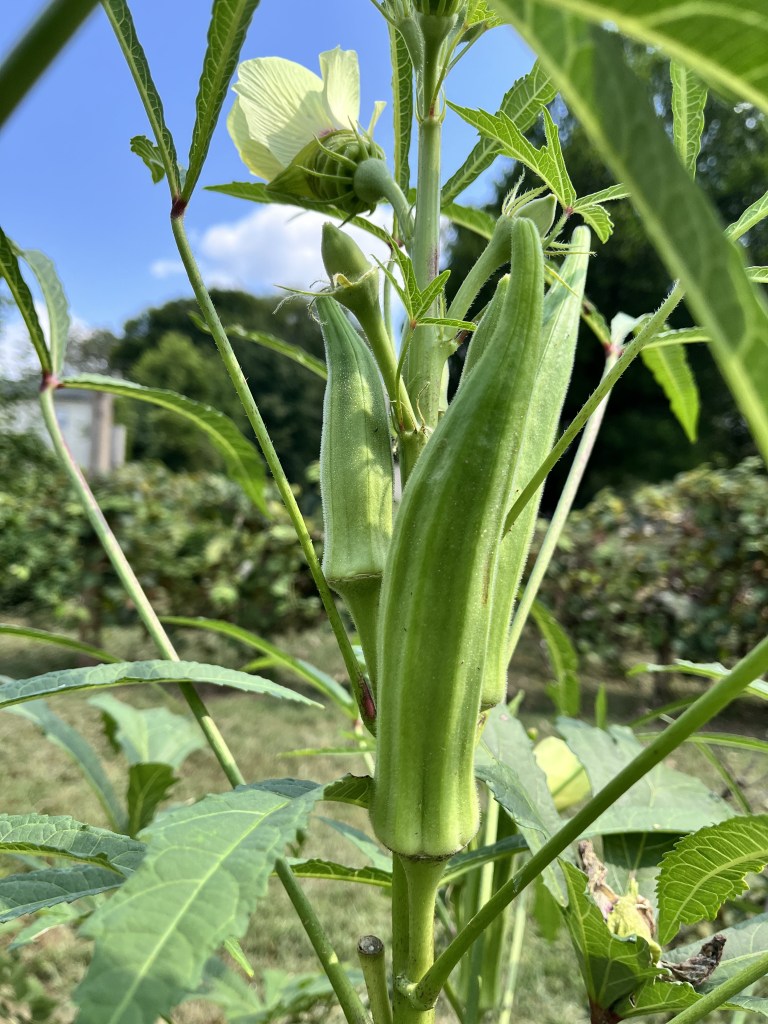
Although I’ve grown okra before, I never got to know it like I did this year. If I didn’t know any better, I would say it was a magic plant. I would pick it on a Monday and as soon as Wednesday it would be full of fresh okra pods again. The more I picked, that faster it seemed to grow. This went on all summer long and into autumn. Each time I was just as surprised that a plant could actually produce that fast along with being so good for you. After a while as all things do, the okra began to send messages. No, it didn’t mail me a letter or whisper some secret word to me in a deep green voice. In a way however, it may as well have because the message it sent to me was loud and clear on the nature of abundance. It’s all around us, if we learn how to recognize it.
Think about it. I planted a single row of okra, and that row kept giving. I didn’t plant an entire field. I didn’t need acres of land or an elaborate operation. I simply planted a few seeds, gave them a place to grow, and kept showing up to harvest what they produced. The more I paid attention, the more I realized that the gift wasn’t just in the okra itself. The gift was in its ability to keep giving. And isn’t that how abundance often works? We sometimes imagine that abundance only means having more land, more money, more opportunities, or more of whatever we think we’re missing. We look toward some distant horizon, waiting for the big breakthrough, when there may already be something growing right in front of us.
The okra reminded me that abundance isn’t always about just having more. Sometimes, it’s about recognizing the extraordinary potential in what we already have. A single seed can become a plant that feeds a family. A small idea can become a business. A little encouragement can change somebody’s direction. One act of kindness can produce a harvest that reaches far beyond the person who planted it. Of course, the okra didn’t grow without the right conditions. It needed sunlight, water, soil, and time. That, too, is part of the message. Abundance may be the gift, but it still needs an environment in which to flourish. We have to nurture our ideas, cultivate our relationships, tend to our gifts, and make room for the things we want to grow. Although, I may not always have time for a big personal garden, I can still plant something. I can still nurture something. I can still participate in the beautiful cycle of planting, growing, giving, and receiving.
So, the next time you see those okra plants standing tall in the summer sun, don’t just see a vegetable. See a lesson in generosity. See how the smallest beginnings can produce remarkable returns. What you plant today may feed you tomorrow… and others too. I know, because I shared plenty of okra with family and friends. I encourage you to go plant something. Start that new venture. Write that story, one line at a time. Begin that art or home project you’ve been rolling around in your mind for the longest. Put that talent to work. You know, the one that’s been waiting to bless both you and the world. Don’t wait until everything is perfect. Plant the seed. Give it some attention. Nurture it. Keep showing up. And when the harvest comes, don’t just count what you’ve gathered. Recognize the abundance that was waiting for you to cultivate it. I once read that growing your own food is like printing your own money. Well, if that’s the case, this summer, okra put me in the Benevolent Billionaire Boys Club with enough to share and still add to my dividends. Now, what are you waiting to plant?