
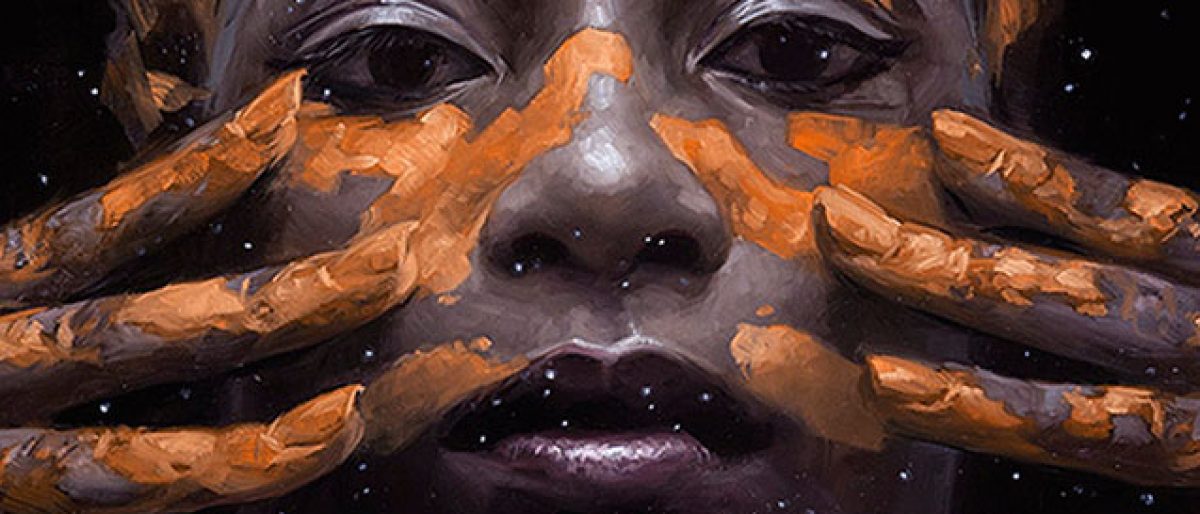
This past weekend, after a family event in Montgomery, we headed west on I80. Our destination was Holy Ground Battlefield in Lowndes County, Alabama.I’m completing Catherine Coleman Flowers’ book of the same name Holy Ground. She signed the book a few months back when we shared the same space in a small church where she was speaking. The jar of red clay on the cover feels much like many I’ve gathered before… so familiar. Red clay has always stirred a soul touching blend of joy, reverence, and a recognition I can’t quite name. Anyone who knows about me knows where red clay lives in my practice. It’s the ancient voice I paint with and believe me when I say that I carry that responsibility with a reverence that’s hard to articulate.
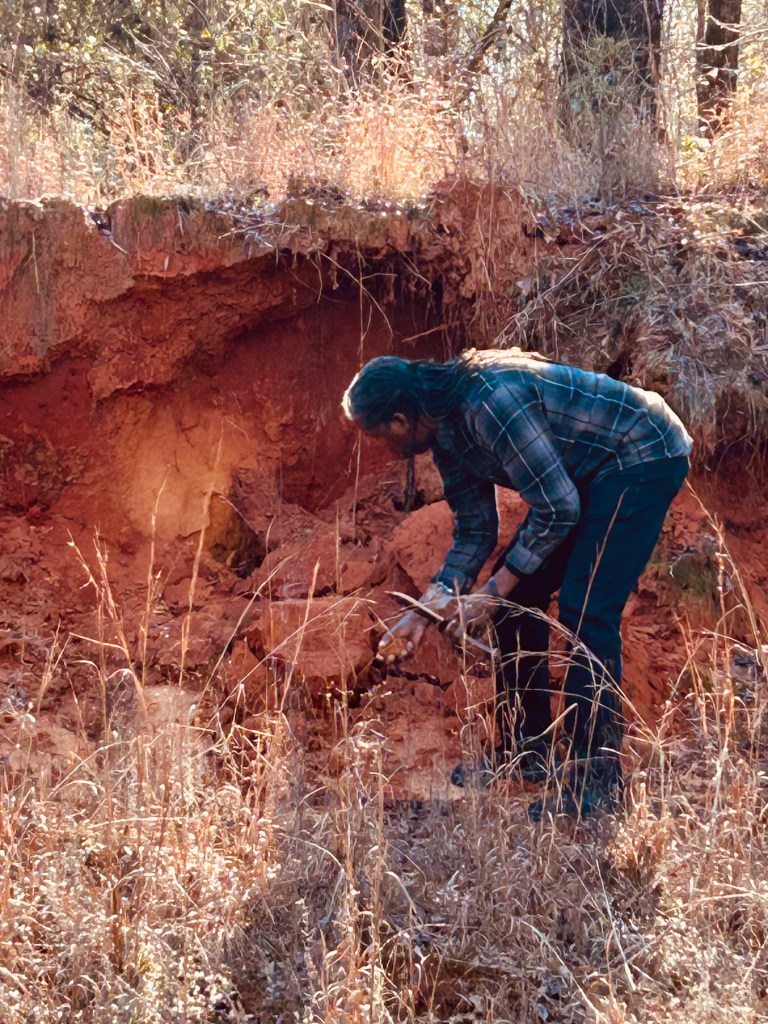
The decision to visit Holy Ground Battlefield had already been made even before we went to Montgomery. I wanted to feel the pulse of that sacred earth space for myself and to gather red clay and water from the Alabama River for a series of art pieces that have been tapping at my mindspace. Pieces that feel less like ideas and more like instructions I’ve been waiting to receive. The moment my feet touched that soil, actually as we drove into the area, there was a strong familiarity, and yet something a bit uncomfortable. It felt as though I’d been there before. There is a pulse beneath Holy Ground. Not metaphorical or imagined but an actual thrum in the earth that moves up through your soles of your feet if you’re still and quiet enough. I felt and listening. We prayed. I high fived a tree. I caressed the soil and let that red clay pour through my fingers. Then I gathered what I needed with gratitude because red clay isn’t something you just take. It’s something you’re allowed to work with. It is rich with the blood of our ancestors, and I never forget that.
In this moment in time when our political world feels jagged, abrasive, and yes, bloody, the earth beneath us still moans with an ancient steadiness. She keeps mothering us, quiet-like and patient, no matter how much noise we make on her surface. Every so often she’ll nudge us with a storm or natural attention getter. Standing on that hallowed land reminded me of something essential: beneath all of our noise, the earth still hums. She hums like a mother who has seen a thousand storms and knows this one will pass. She hums because life runs deeper and higher than whatever headline we’re distracted by. She hums because she remembers who we are, even when we forget. Red clay, for me, is part of that remembering. It holds the trace of every foot that has ever pressed into it, barefoot or booted, every struggle, every prayer, every moment of resistance and rebirth. I dance with its resiliency and it constantly speaks to me. Painting with it is painting with history, with blood, with echo, with the marrow of the land itself. It’s not just a pigment, its presence.
And as I walked back to the car with that red clay and river water tucked inside, I am renewed in a baptismal kind of way.What I do with this red clay isn’t just painting; it’s invocation. It’s listening to what the land remembers and allowing that memory to move through my hands. It’s transforming earth back into story. The pigment becomes portal. It’s granting me access to a lineage older than any of us, and honoring the unseen forces that rise when the material world is treated with respect. This work is my way of staying in conversation with the ancestors and the landscape that shaped them. It’s also my way of reaching down through time to those who will come after. It’s my form of alchemy, turning raw soil into embodiment and testimony. It’s animism in the truest sense, recognizing that the blood, sweat, and tear-rich clay is alive, aware, carrying intention of its own. I don’t force it; I flow with it. The art pieces that come from Holy Ground will carry much more than color. They’ll carry pulse and presence. They’ll carry the truth that the earth is not just beneath us, but with us. I am honored to be its translator.
I left Holy Ground, but I can still feel that pulse ringing in me. It will make its way into the work, into the surface and textures and forms that are waiting. Perhaps that’s the quiet gift red clay keeps offering: the reminder that we are always standing on more than ground. We are standing on the accumulated spirit of those who came before and the unwavering patience of the earth that carries us all. In remembrance of this and standing up to our full height measured in humanity, not inches, every step we take can be holy ground.

 Notes of A Native Son