We Are The Monuments…

We’ve all, at some point, walked past monuments built by others, honoring others. Why do we wait for someone else to honor our stories? What happens when we realize we are the monuments, the living, breathing proof of endurance, imagination, and grace? Our buildings aren’t just brick mortar, and glass. Our art is never just paint on a surface. They are evidence of belief and resolve that refused to fade. It’s the kind of creation that reminds us our presence is the monument, our work the foundation, and our progress the pedestal upon which our future stands.

Some Wise Dude


About a year or ago I got a call from a fella, telling me he needed a mural done on the FX Market on Pulaski Pike. Now, mind you, I used to get a lot of spam calls like that. So much so that I was advised to remove my phone number from my contact information. The gentleman on the other end was Vincent E Ford, serial entrepreneur working on a plethora of projects. He said he’d tried to reach me two years prior. We set a meeting and went from there. At our first meeting, I felt I knew him from somewhere. He tuned in to the familiarity, so we started climbing the family tree.  We did have some people in common but only by marriage. I came to know that he had a construction company, a flagging company, some housing developments, an event center in the works, and one other FX Market gas station before the one upon which he wanted the mural painted. For some reason, it didn’t take long for us to begin bantering like we were old friends. 

When he came through on the mural and shared his why, I felt better about the project. The subject matter was The Buffalo Soldiers, the U S 10th Cavalry Regiment that had camped on a hill near the FX Market site in the late 1800s because they were not allowed to stay with the white soldiers.  At first the idea of painting this on a gas station didn’t thrill me. After some consideration. I came to realize it was the best place. Besides, I’d already activated the land long before I knew who was doing something with it when I had exhumed red clay from the site.  This was people’s art and all types of people patronize gas stations. It wasn’t just about painting on a gas station, it’s creating legacy in so many ways. And this isn’t just a gas station; it’s a monument honoring monuments.

In the 1960s, according to local historians, there were at least four Black owned gas stations in the Huntsville/Madison County area. Currently, according to one study there are only four in the entire state of Alabama. Two are here in Huntsville/Madison County and Vincent Ford is the proprietor of them both. He had an idea, dreamed it up, and brought it to pass. At the end of the day, we all need gasoline, right. The first one he built is on family land in Harvest.  The other one (with the Buffalo Soldier mural) sits on Pulaski Pike across the street from Northwoods Public Housing Community where he grew up, and the namesake Historic Space after the Buffalo Soldiers, Cavalry Hill. It stands as a testament to belief beyond borders, and attitude determining altitude. What started as a request for paint on a wall between us became something bigger, a mirror held up to what’s possible when vision meets purpose. His gas stations aren’t just a business; they are a declaration that our stories belong in full color, on our own walls, in our own neighborhoods. A gentleman stopped and inquired about the FX Market gas station one day. He had heard it was Black owned. I affirmed. He smiled as he pulled off and said on repeat, “We comin’ up.” I felt his sense of pride and resolve echoed in the declaration. So if you’re reading this and haven’t gone by. Do so if for no one else but yourself. This is an investment in us. When we see what we can do, it gives us the inspiration to continue to do.

This is what happens when belief outlives circumstance. When we stop aiming for the idea of Black excellence and start setting the reality of a Black standard, where ownership, craftsmanship, and community care are the norm, not the exception. When we build, we build for generations to come. When we create, we create capacity. And when we pour into our own, the return is legacy. That mural isn’t just about art in public space. It’s about arrival. A reminder that we don’t just dream beyond our address, we redefine it.

The Earth Never Forgets

Late last year I had the honor of attending an Equal Justice Initiative and Community Remembrance Project posthumous memorial service and marker dedication for one Robert Mosley. In 1890 Robert Mosley was dragged away from life in Meridianville, Alabama, hung by an enraged mob of over 450 men. This southern son’s light was snuffed out in broad daylight. This act of homegrown terrorism was carried out not by the courts, but by self-appointed executioners, fueled by fear-based hatred and the presumption of guilt. Robert Mosley’s age was somewhere between 16 and 19. Basically a child.

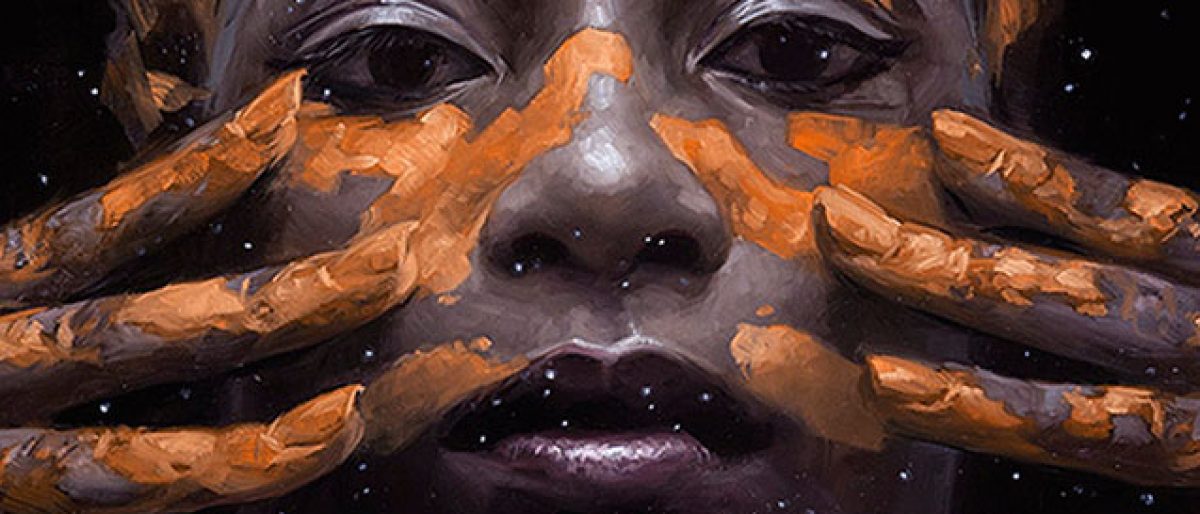
I had the challenge and honor of doing a portrait of Mr Mosley in red clay which I gathered from the area of his murder. Working with red clay gives me the feeling of working with a living substance. It is, as a professor once told me, “rich with the blood of y(our) ancestors.” The red clay that forms this image is not merely pigment. It is a reminder of the blood shed on this southern landscape for what we now call home. This painting calls us to bear witness—not just to the life of Robert Moseley, but to the countless others whose names have been forgotten in the ashes of social violence.

During the ceremony, the photographer approached me about the portrait and his camera’s interaction with the eyes. He explained to me the sensitivity of his AI powered camera – how it could detect human eyes. He went on to say that it was reading the eyes of the portrait as human. I heard him but didn’t think anything of it. Several times more in passing he would comment on it, in obvious awe. Finally at the end of the ceremony when he was taking a photo of another gentleman and myself next to the piece, he came over shaking his head and said, “You’ve got to see this!” he proceeded to tell us that the camera had actually recognized the portrait’s eyes before it had ours. In the camera, I saw the green dots focused in on the eyes of the portrait of Robert Mosley. If I’d had another mindset, it could have come across as eerie. Obviously, to him it was rather fantastical and somewhat unbelievable.

At home that evening, I found myself looking through the photos of the program online. The words on the posterior of the marker read.

With his last words, Robert reportedly objected to the mob’s covering his face with a handkerchief, pleaded, “Let me see one more time in this world.”

As I read those words, a chill ran through me. Let me see one more time in this world. And here was this portrait—his likeness, his spirit—being recognized by an artificial eye meant only for the living. The thought settled deep in my chest. Had I, in some way, created a portal for his sight? Had the clay, the very earth itself, become a vessel for something beyond my understanding?

Sitting in the dim glow of my screen, I stared at the image—still seeing in my mind’s eye the green dots locked onto his eyes. It’s as if the camera, too, was acknowledging his presence. Maybe it was just technology behaving strangely. Or maybe, just maybe, Robert Mosley finally got the chance to see in this world one more time. After all, it is A.R.T. …A Resurrecting Truth.

If Not…For The Birds

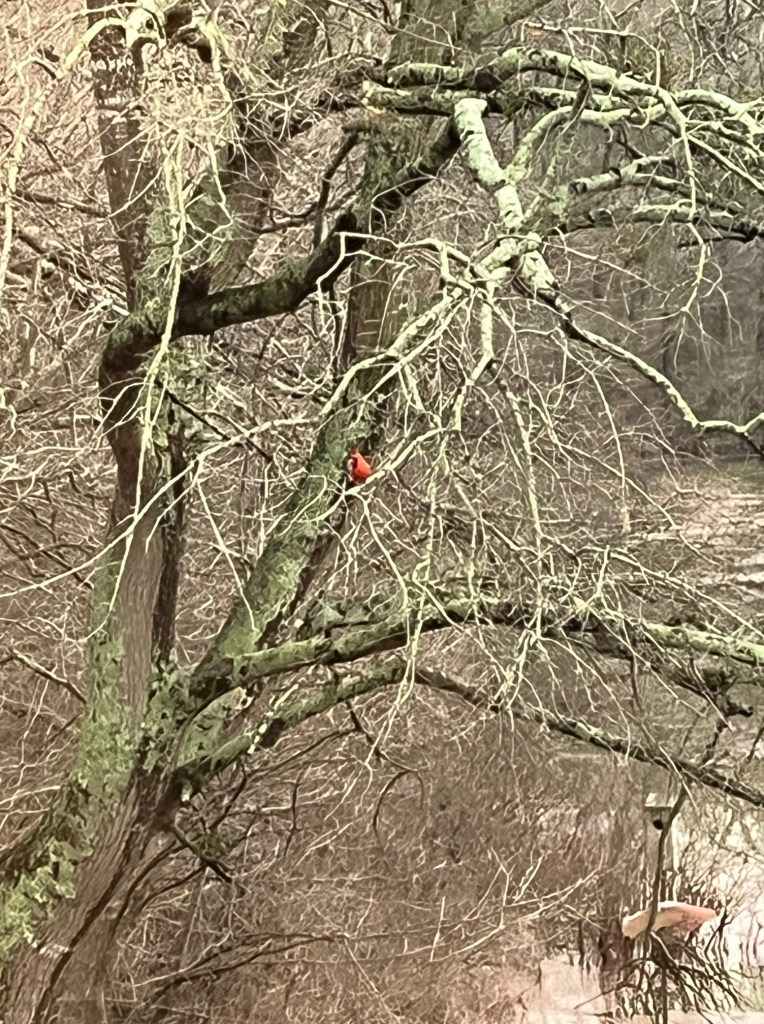
This year, I had the privilege of attending the renowned Festival of Cranes—a celebration of grace, migration, and one of natural world’s many intricate dances. While the elegant sandhill cranes captivated the crowds, my own attention was pulled away by an unexpected guest: a back a forth game of male cardinals darting through the naked wintry limbs, the red plumage striking against the bare landscape. This simple encounter took me on a journey of reflection, one centered on hope, intention, and the messages we receive if we pause to notice.

As a child, whenever we spotted a cardinal, we’d shout, “Redbird, somebody comin’!” It was part superstition, part playful belief that the bright flash of red was a herald of change, a sign that someone—or something—was on its way. Back then, we didn’t think much of it beyond the joy of the moment. But as I stood there watching the cardinal at the Festival of Cranes, I felt the significance of that childhood exclamation in a new way.

Cardinals have long been seen as symbols of hope and renewal. Their brilliant crimson feathers stand out unapologetically, even in the bleakest seasons, reminding us to embrace our individuality and worth. They seem to carry messages from beyond—a gentle nudge to reconnect with faith, spiritual practices, and the peace that comes from being present. In their quiet grace, they offer a sense of life’s continuity, a whisper that even in hardship, beauty endures.

That day, watching the cardinal, I felt these lessons deeply. It wasn’t just a moment to observe but a call to participate—to take the hope the cardinal symbolized and turn it into intention. Hope, when passive, is like a seed left unplanted. To elevate it into intention means to act on it, to let it shape how we move through the world. The cardinal’s red plumage wasn’t just a signal to stop and notice; it was a challenge to lean into that moment of reflection and ask, “What next?”

I carry the memory of the cardinal with me, its image etched into my mind as a vivid reminder to live with intention. The cranes taught me about harmony and connection, travel and poise while the cardinal urged me to take those lessons and weave them into my daily life. Hope, I realized, is not just something to feel—it is something to live…on purpose.

The next time you see a cardinal (or anything that pulls your attention away from the order of the day), pause. Breathe. Let its message remind you of hope, not as a passive lottery style wish but as an invitation to act, to engage. Take that hope, plant it, and nurture it into something that can grow and sustain you—and perhaps others. After all, “somebody” is always coming. Maybe it’s you.