This Is It

As I am writing this I hear the echo of DMX’s gravely bass growling, “Lord gimme a sign.” In the same song he says. “No weapon formed against me shall prosper/And every tongue that rises against me in judgment, thou shall condemn.” This is a truth I hold to be self evident and I invite you to do the same. At some point in our journey we’ve found our weight unusually heavy. Our path gets overshadowed and the way blurs in front of us. In those times we’ve asked for some word, some clue, some sign to let us know what to do or where to go from here.

Allow me to share a short fable about a great oak tree that grew strong on the edge of a cliff. Its roots gripped the rocky ledge. The tree was battered day after day by windstorms, rain, and scorching sun. Every other tree in the softer soil of the valley grew faster, looked fuller, and seemed more secure. But when the storms came, those trees were the first to feel the brunt of the winds and rain. They fell. The oak held firm. Why? Because it had been tested. Every storm, every gust of wind, or shudder of the earth had made it dig deeper, reach further, and grow stronger. It didn’t just survive the storm—it was shaped by it. That oak is us.

Right now we’re living in a time where many feel they can’t go on like this. True the weight of uncertainty can feel real. But please be reminded that deep down inside is a place within us that is always certain. The winds of change are howling and it’s easy to wonder if we’ll make it through, if we’ll get by. But there’s a part of us that knows we will. I want to remind you of this as well: trouble don’t last always. And more than that, it doesn’t get the final word. In fact, it’s often in the pressure—the pushing, the waiting, the stretching, the longing —that the best in us rises. We discover grit and grind; we didn’t know we had. We learn to dig deeper, think sharper, love harder, and spread hope wider. We were made for this.

When the going gets tough, we don’t just endure—we evolve. We double down. We link arms with those who are on journey with us. We get creative. We hustle. We pray. We build. We were never meant to fold—we forge. This opposition is not the end. It’s the sharpening stone. It’s what is going to make us shine all the more bright. Hold on. This moment is not the breaking point—it’s the turning point. We will win—not because it’s easy, but because it’s in us to do. We have a power that cannot fail. Hold on. Hang in. Push forward. This storm isn’t here to take us under. It’s here to reveal us. If you’ve been waiting for a word or a sign. This is it…

Now

The other day my daughter sent me a photo of a cicada having just emerged from its shell. The shell or husk of this singing creature we call in the south, July Fly, is called the exuviae. I admit that as much as I love nature, that was new news to me. Exuviae seems like such a grand title for something to be left behind. As a boy, I would invest some precious time gathering these exuviae for various lofty purposes. One of them being placing them in strategic places (like on the collars of shirts) to scare the heck out of my sisters and their friends. In the photo, the new olive green, black splatterred cicada is perched a slight distance away from its exuviae. It was still stuck to the side of the porch, looking like a relic from a past self. And there was its former content, the cicada itself; raw, fresh, and very much alive. What struck me most was the timing. It’s pretty early for it to be out. Too early, maybe. The others haven’t arrived yet. The trees aren’t humming with that familiar chorus that signals summers arrival. And yet—this cicada was already here…now.

That moment held a mirror to the creative life. We are, many of us, called to emerge before it’s comfortable. To come forth and close the gap between the present and later. To break open, transform, and show up even when the timing feels off or the world doesn’t seem ready for what we have to offer. Maybe especially then it’s more important. Living a creative life—especially in times like these—can feel like crawling out of a shell when no one else is watching or exposing yourself to the harsh elements of life too soon. You may wonder if you’ve misread the signs. If you’re out here alone. If the world will catch up or just keep turning without noticing… or fully reject the you that you really are.

Here’s the truth the cicada whispered to me: Transformation doesn’t wait for perfect timing or a set date. It happens when it’s ready. Oftentimes even before you feel you are ready. And readiness doesn’t always look like safety or certainty. Sometimes it looks like being the only one brave enough to show up and shine in your truest form. As artists, thinkers, makers, dreamers—we don’t always get the chorus or even a go for it. Sometimes we just get the barely heard whisper to begin.

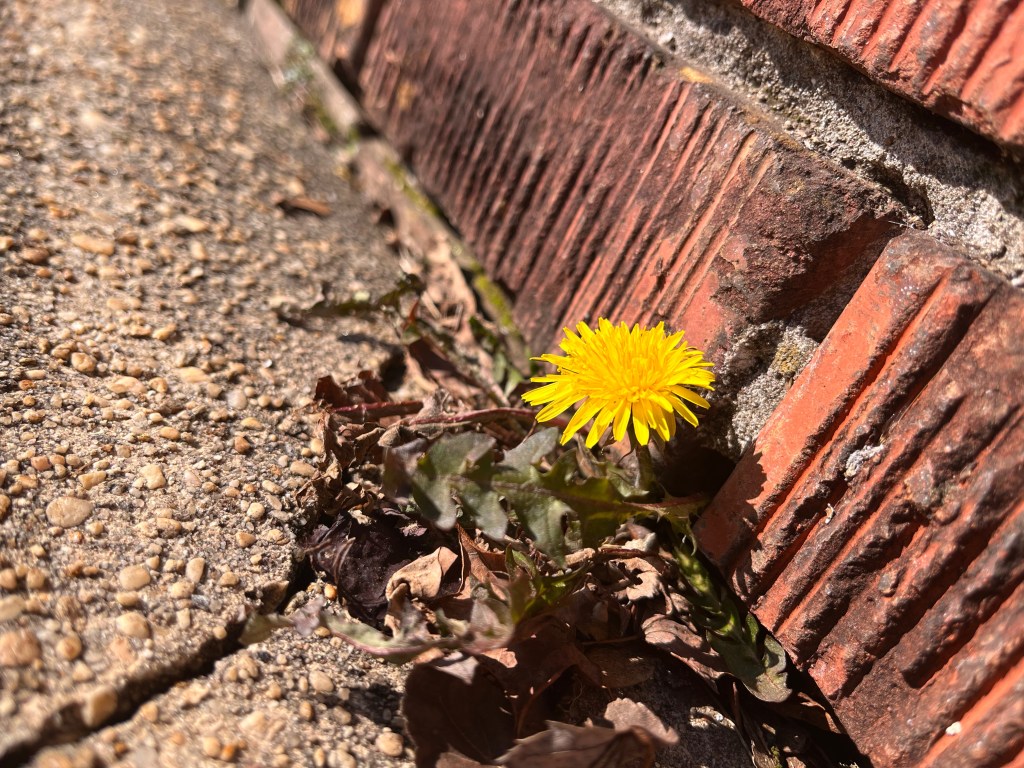
So today, let this be your sign: It’s okay to emerge. To come out and be who you really are and do what you do. Even if it seems too early. Even if your world seems quiet. Your creative life is not tied to the crowd or the calendar. It’s tied to the truth inside you, pulsing with its own rhythm, knowing when it’s time to break open. You hid long enough within the shell that may have protected you, but it’s no longer who you are now. Step out. Create, write, speak, plan, sing, build, sign up. Become luminous and let your light shine without apology. Leave that exuviae behind. Be here now. The world will not only adjust to you, it needs you – the real you.

Cosmic Conduit

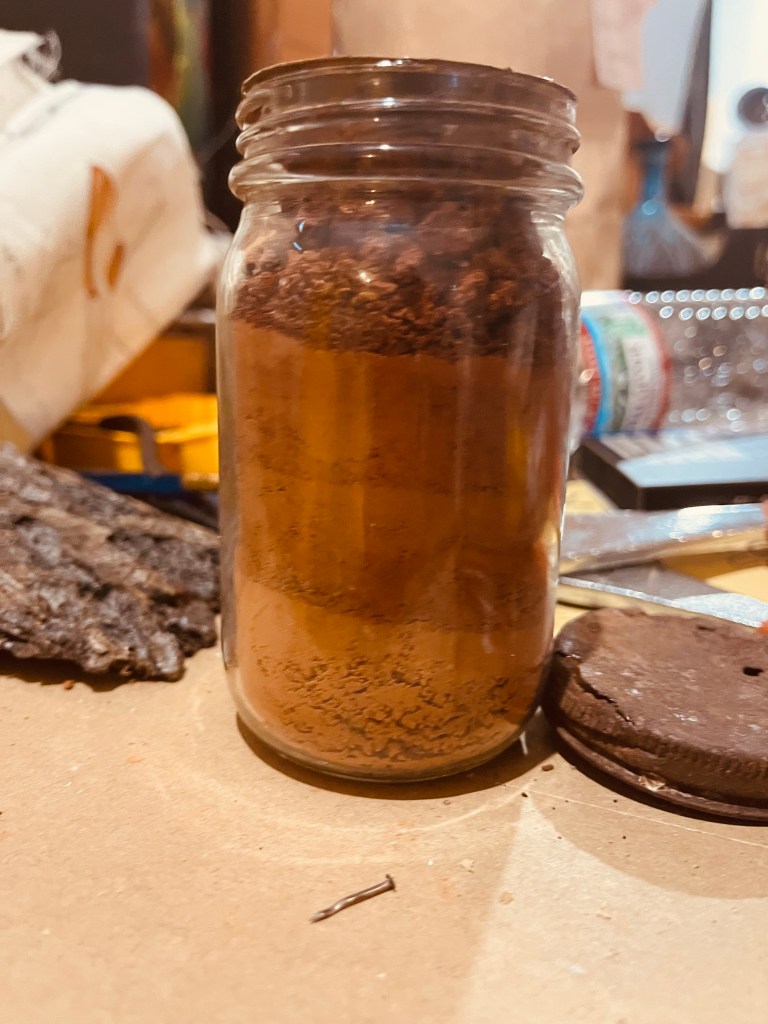
From childhood, the red clay of Alabama has been more than dusty earth beneath my feet — it’s been companion, witness, keeper, and quiet participant in this life’s southern screenplay. Those deep, iron-rich hues tell tales far older than roads, houses, or city outlines. This clay, saturated by millennia, holds within it the memory of those who walked, worked, sweated, prayed, and bled on it. I recall a professor once telling me, “This Alabama red clay is rich with the blood of your ancestors.” It was then that I began to understand — this soil is not just ruddy dirt; it is charged matter, a living archive.

In the age old folk wisdom of the South, particularly in the African American tradition, earth is not a passive object or substance. Clay and soil have long been used as vessels for intention — for grounding, for protection, for healing, cleansing, and for calling forth what is unseen. The red clay in particular, with its rich iron content, acts almost like a spiritual conductor, transmitting energy between the seen and unseen worlds. It anchors prayers, catches tears, and carries whispers into the earth’s core. But its power extends beyond the personal or mystical — it is cosmic. Science teaches us that the same iron oxide that reddens Alabama clay also exists in places like Morocco, Tehran, Nigeria, Kenya, and yes on the surface of Mars, giving the planet its scarlet glow. There’s something poetic in that: this humble dirt is a terrestrial mirror of a celestial body, connecting us to the wider universe. How we walk should not be common because what we walk upon is not ordinary — it is stardust, drawn down to earth, thickened and spread by time and memory.

This allows me to weave this red clay into my work not as a symbol of something superstitious, but as a tangible metaphor for what binds us all: dust to dust, earth to star, ascendant to descendant. It’s a reminder that our faith traditions, though varied, often share this same foundational truth — that life is cyclical, that spirit moves through matter, and that the earth itself is a key element in the divine story. I have come to see red clay as a sacred material. It quietly affirms what so many faiths already teach — that we are intimately connected to both the earth and the heavens. We are tethered to power. May each step we take upon this hallowed ground remind us of our origin story, our resilience, our rootedness, and our inevitable rising.

If Not…For The Birds

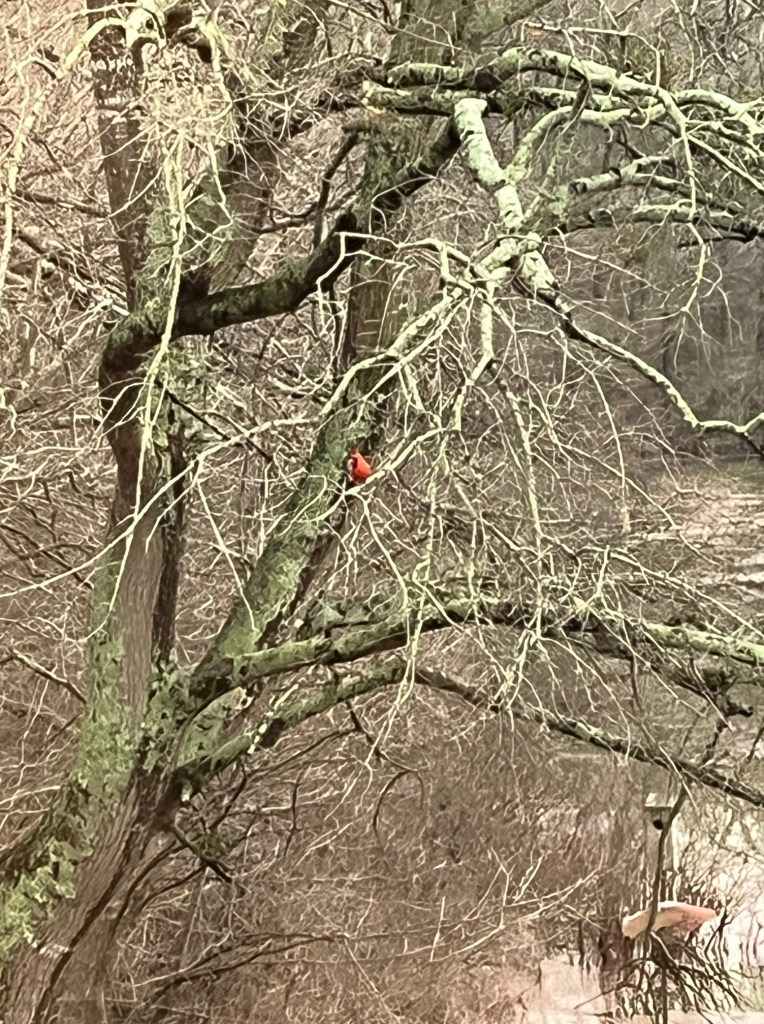
This year, I had the privilege of attending the renowned Festival of Cranes—a celebration of grace, migration, and one of natural world’s many intricate dances. While the elegant sandhill cranes captivated the crowds, my own attention was pulled away by an unexpected guest: a back a forth game of male cardinals darting through the naked wintry limbs, the red plumage striking against the bare landscape. This simple encounter took me on a journey of reflection, one centered on hope, intention, and the messages we receive if we pause to notice.

As a child, whenever we spotted a cardinal, we’d shout, “Redbird, somebody comin’!” It was part superstition, part playful belief that the bright flash of red was a herald of change, a sign that someone—or something—was on its way. Back then, we didn’t think much of it beyond the joy of the moment. But as I stood there watching the cardinal at the Festival of Cranes, I felt the significance of that childhood exclamation in a new way.

Cardinals have long been seen as symbols of hope and renewal. Their brilliant crimson feathers stand out unapologetically, even in the bleakest seasons, reminding us to embrace our individuality and worth. They seem to carry messages from beyond—a gentle nudge to reconnect with faith, spiritual practices, and the peace that comes from being present. In their quiet grace, they offer a sense of life’s continuity, a whisper that even in hardship, beauty endures.

That day, watching the cardinal, I felt these lessons deeply. It wasn’t just a moment to observe but a call to participate—to take the hope the cardinal symbolized and turn it into intention. Hope, when passive, is like a seed left unplanted. To elevate it into intention means to act on it, to let it shape how we move through the world. The cardinal’s red plumage wasn’t just a signal to stop and notice; it was a challenge to lean into that moment of reflection and ask, “What next?”

I carry the memory of the cardinal with me, its image etched into my mind as a vivid reminder to live with intention. The cranes taught me about harmony and connection, travel and poise while the cardinal urged me to take those lessons and weave them into my daily life. Hope, I realized, is not just something to feel—it is something to live…on purpose.

The next time you see a cardinal (or anything that pulls your attention away from the order of the day), pause. Breathe. Let its message remind you of hope, not as a passive lottery style wish but as an invitation to act, to engage. Take that hope, plant it, and nurture it into something that can grow and sustain you—and perhaps others. After all, “somebody” is always coming. Maybe it’s you.

Embracing The Journey

Last week, a snowstorm blanketed the East Coast, transforming familiar landscapes into frosty white humps. At the same time, we bore witness to newsreels of wild fires raging in California. The entire picture is a stark reminder of our divided literal and metaphorical climates. It’s hard not to see the symbolism: two extremes, mirroring the polarization of our times.

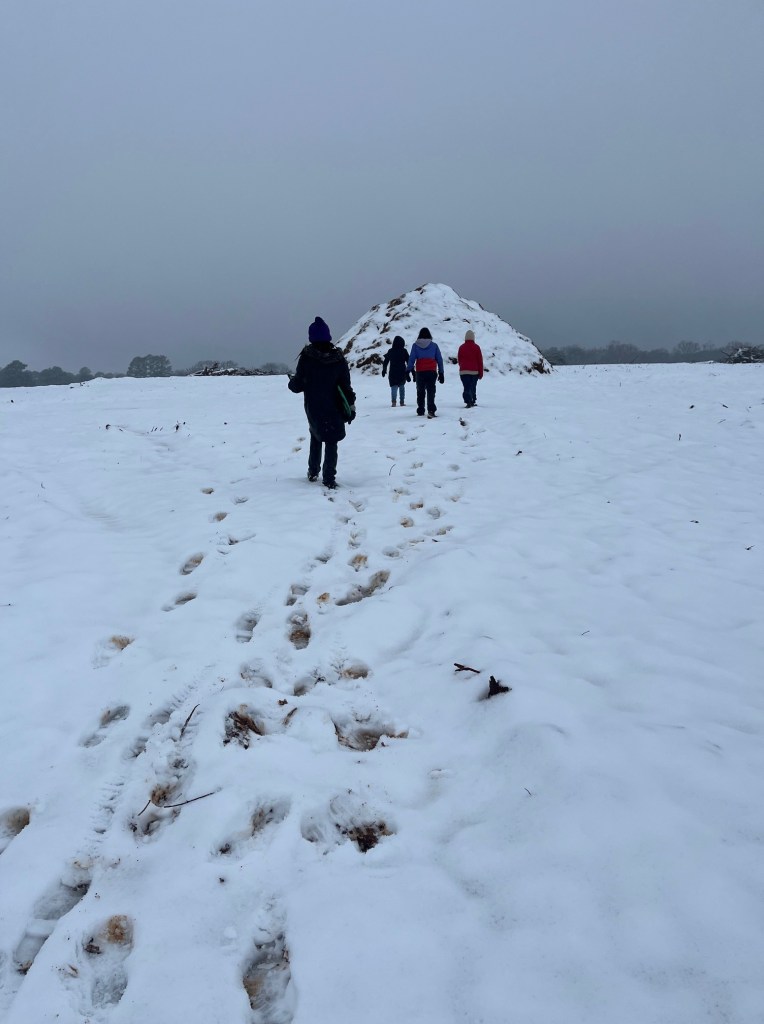
In the aftermath of the storm, we decided to embrace the weather and hit the great outdoors. We had actually been hoping for snow. When we get it in my neck of the woods, it’s generally in celebration. The air was crisp, and the fresh snow muffled the world around us. This offered a rare stillness around our voices of laughter as we sculpted snow creatures then armed ourselves with snowmunition and went to war. The day was escaping so we called a truce and took off hiking. As the group trudged ahead, I hung back taking in the scene: the path we carved through the snow, my family in motion, and the destination up ahead. It struck me then how much this mirrored life itself. Yes, I do think a lot, even at times like this. So often, we fixate on where we’re going—the summit, the goal, the resolution—that we forget to savor where we are in the moment. Each step becomes a task rather than a part of the experience. And yet, those steps are where the magic happens. The crunch of snow underfoot, the shimmer of sunlight breaking through snow-heavy branches, and the sound of my youngest daughter’s voice asking how much longer—these moments are the journey.

And then there are the tracks we leave behind. Looking at the trail behind them, I thought about the impression we make for others who watch us, who come after us. Our choices, our actions, and even our mistakes make paths that guide, hinder, or inspire those who follow. The clarity of a single set of tracks through fresh snow can be reassuring, a beacon for others to navigate unknown terrain. This perspective feels especially relevant in our current world, where extremes—both in weather and in society—seem to dominate. Fires and storms, division and connection. In such times, our steps and our awareness of them matter more than ever. The way we walk—with care, intention, and respect—can influence not only our journey but the paths and way we forge for others.

So as we move forward, let’s challenge ourselves to make the most of where we are. Make the most of today. Pause to admire the view, acknowledge the effort it takes to keep moving, and be mindful of the impact we leave in our wake. Whether we’re navigating snow or fire, literal or figurative, we really do have the power to shape the journey—for ourselves and for those who follow. With due diligence the destination will come soon enough. But it’s the trail we carve and the tracks we leave that tell the real story. The map will be here long after we’ve gone where we went.

Voyage To Now

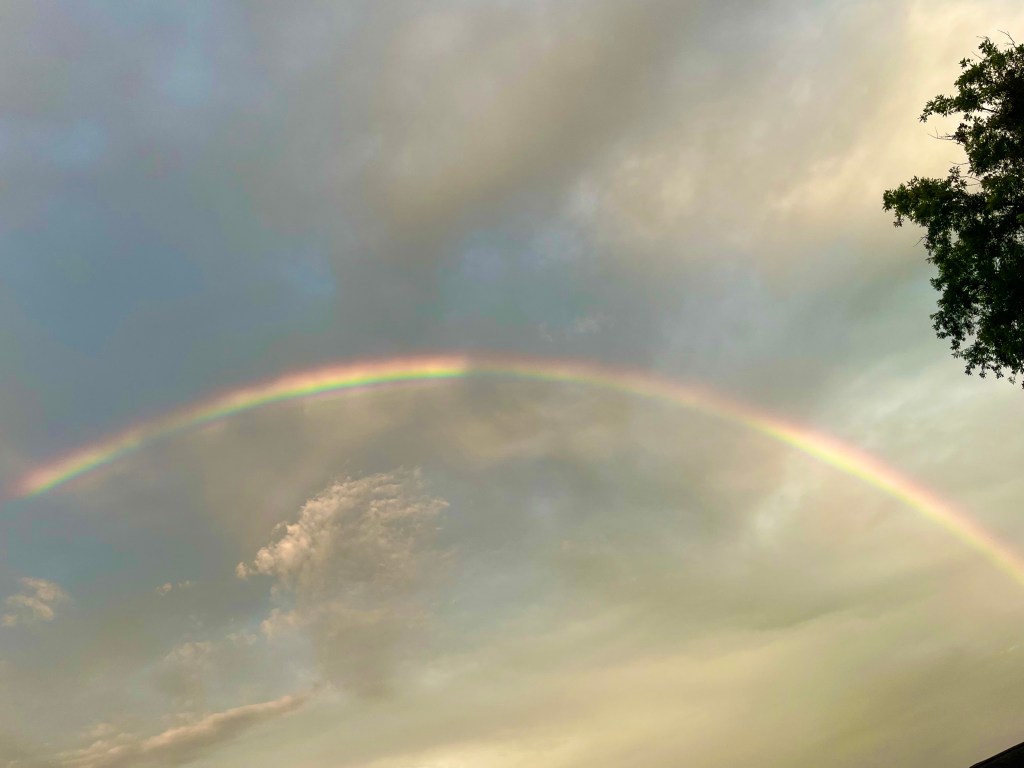
As a child, I invested healthy chunks of afternoons and evenings lying with my back snuggled into the grass in my parents backyard staring up into the sky. Sometimes I would wonder what was out there. Mostly, I’d find shapes in the clouds, watch them float and transform, or when there were none, feel the wash of the calming blues stretching into forever. I couldn’t explain it then but that intense purposeful sky gazing was a lesson in mindfulness, being fully present in the moment. The intense gaze into the heavens took up all the space of yesterday and tomorrow, transporting me fully into those present moments. In the nowness of it all, I felt that no matter what, everything was alright right then and there.

As of late, I have come to the knowledge of a word called skychology.  Skychology is is a new area of wellbeing research, defined as the study of the relationship between looking at the sky and wellbeing . It’s been proven that the act of looking up at the sky can provide a sense of perspective and calm, making one’s problems and worries feel small in comparison. Furthermore, the big blue yonder brings about an increase in mindfulness, stimulates creativity, and providing mental health benefits at no cost but a glance upward.

Who knew? Apparently, I did, my friends did, and you probably did too. We didn’t have a name for it back then, but in our spirit we knew the sky had something to offer beyond planes and an occasional spaceship . We knew how it made us feel and where it took us. As children we accept what we accept without overthinking and smothering the moment with analysis. For me the sky was the embodiment of the word possibility. The 20th century artist, Pablo Picasso frequently called out being like a child as a characteristic of a great artist. One of his famous quotes reads…

“Every child is an artist. The problem is how to remain an artist once we grow up.”

Let us look to the sky and allow it to transport us into the now. Through the eyes of our inner child, we can behold the world anew. Simply allow yourself to be aware of something that’s always there. Night and day, through all seasons, good days and challenging times do not take away the sky’s healing powers. I’m sure you’ve heard that the best things in life are free. The effects of sky gazing, no doubt, one of them. Plug in when you can, there’s no charge.

Consider the idea of the sky as a canvas. The art reflects the artist. As the luminary Wintley Phipps once said. “God created this world from the timber of his creative imagining.” What if we saw the sky is a divine canvas, ever present, stretched overhead, free to all to reap it’s benefits. A space that is sometimes blank and sometimes predesigned to to put our lives in perspective. Back then, I didn’t know I wanted to be an artist when I grew up but the artist in me already knew. It was offering to me, the artist to be, a front row seat to the most expansive canvas of all time and the most precious moment, now.