Esperanza

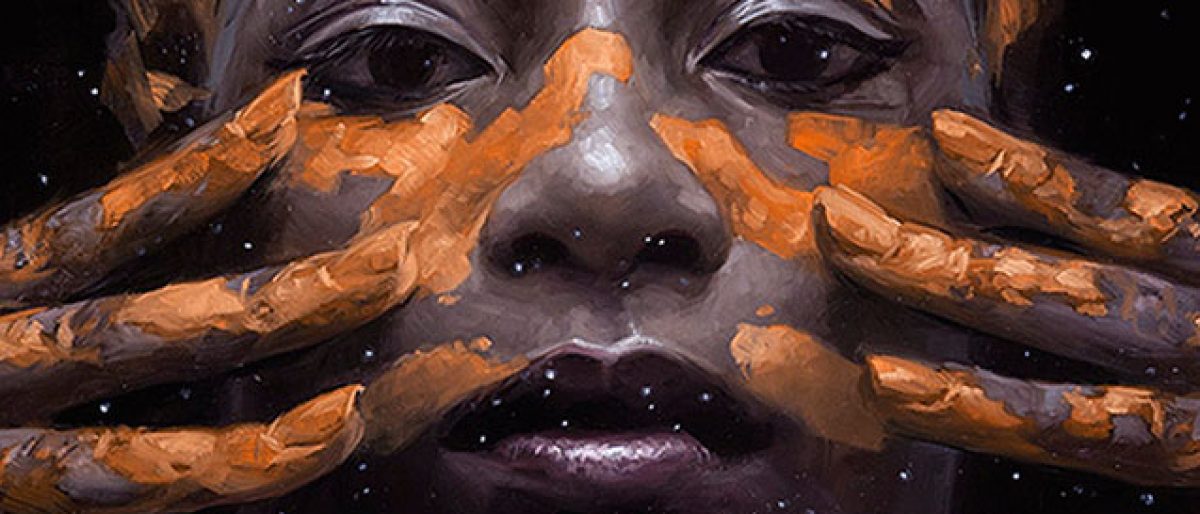
  It was 2014,  on the eve of my hearing of the passing of the legendary luminary Maya Angelou that I penned these words held buoyant by hers, “Bringing the gifts that my ancestors gave, I am the dream and the hope of the slave.”  For the last few weeks I’d walked in the challenge of addressing, through art, the theme of violence in Colombia.   Colombia was enslaved by a history of violence that continues to taint its present color in the eyes of the rest of the world.  In my time there, from speaking on the panel with the mayor of Medellin downtown at the Mayo por la Vida Celebration, to walking the neighborhood streets of rural Apartado with school age children; I saw the power of the very thing that Maya Angelou talked about-hope.  Hope, not the one that sits and reaches out to nothing and just waits. No. Hope, that unsinkable mindset that hovered above me night after night as I pondered the depth of the question asked of me many times during my sojourn there, “Do you really believe in world peace?” Each time, the question hit me like a dark wave threatening to drown the belief in change to which I clung ever so tightly.  

   One evening I had the honor of visiting a three year old girl who had been shot just days before.  As I knelt down beside her, without hesitation or concern she reached out and put her tiny arms around my neck and gave me a hug that could have embraced the world. In her sunshine smile and angelic eyes I saw what I needed to see, my answer, the reason I was doing what I was doing.  I saw hope in its purest form shining onto my faith and casting away any shadow of doubt that may have been lurking in my mind. Not the type of hope that sits waiting, internally pleading for something to change, but the kind that continually rises up in the face of all that would suppress us.  The Spanish word for hope is esperanza. That little crippled girl awakened in me a renewed sense of hope.  Esperanza was echoed in the face of every child and Colombian I saw from that point onward. I always reminded myself that there’s always a way.

  I am an artist, and art is my weapon of choice for peace and justice. What I mean by justice is that which I want for myself, I also want for others. I bring, like Maya Angelou said, the gifts the ancestors gave and I use them for the enriching of this planet we are blessed to inhabit.  Although I was a speaker of English in a Spanish speaking country, art is a universal language, and her most vivid color is love. I was met with the spirit I came with. I walk with art as agency for change. Change is coming. Not only do I believe it, I know it because I saw the preview of a new world reflected in the eyes of the children who looked into mine. And in their smiles and attitudes I saw the blueprints. That isn’t political or scientific, or any other form of measurable statistic.  It’s the power of esperanza. Where there is life, esperanza (hope) lives, and where she lives, change is inevitable. Hold on.

If Not…For The Birds

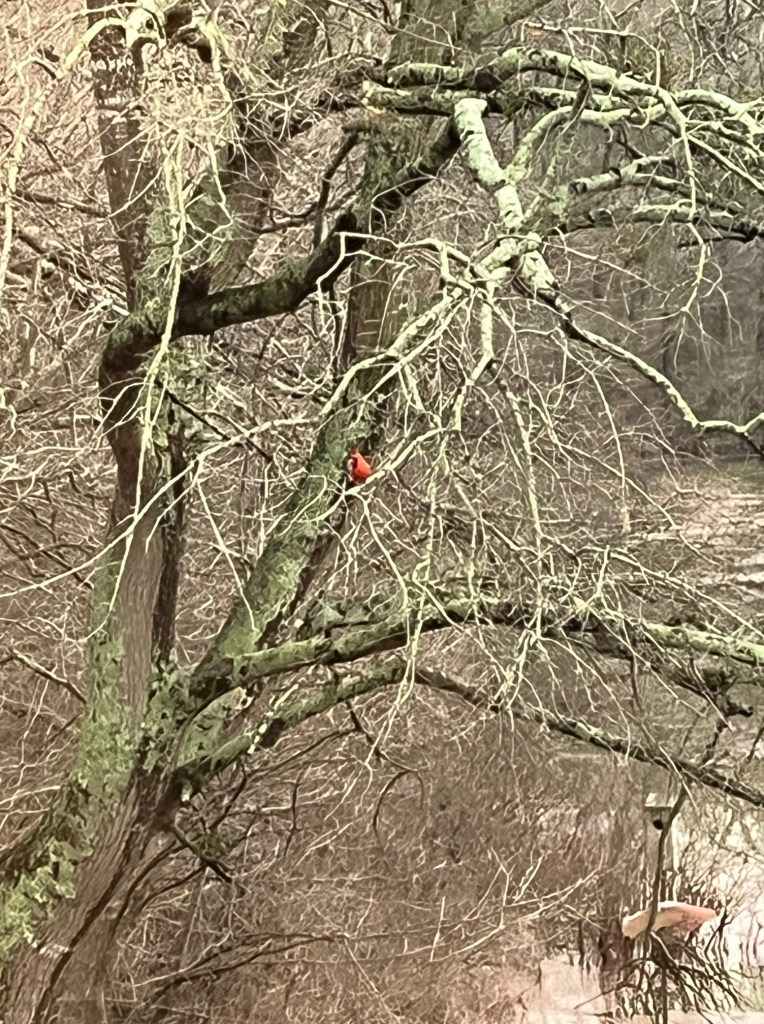
This year, I had the privilege of attending the renowned Festival of Cranes—a celebration of grace, migration, and one of natural world’s many intricate dances. While the elegant sandhill cranes captivated the crowds, my own attention was pulled away by an unexpected guest: a back a forth game of male cardinals darting through the naked wintry limbs, the red plumage striking against the bare landscape. This simple encounter took me on a journey of reflection, one centered on hope, intention, and the messages we receive if we pause to notice.

As a child, whenever we spotted a cardinal, we’d shout, “Redbird, somebody comin’!” It was part superstition, part playful belief that the bright flash of red was a herald of change, a sign that someone—or something—was on its way. Back then, we didn’t think much of it beyond the joy of the moment. But as I stood there watching the cardinal at the Festival of Cranes, I felt the significance of that childhood exclamation in a new way.

Cardinals have long been seen as symbols of hope and renewal. Their brilliant crimson feathers stand out unapologetically, even in the bleakest seasons, reminding us to embrace our individuality and worth. They seem to carry messages from beyond—a gentle nudge to reconnect with faith, spiritual practices, and the peace that comes from being present. In their quiet grace, they offer a sense of life’s continuity, a whisper that even in hardship, beauty endures.

That day, watching the cardinal, I felt these lessons deeply. It wasn’t just a moment to observe but a call to participate—to take the hope the cardinal symbolized and turn it into intention. Hope, when passive, is like a seed left unplanted. To elevate it into intention means to act on it, to let it shape how we move through the world. The cardinal’s red plumage wasn’t just a signal to stop and notice; it was a challenge to lean into that moment of reflection and ask, “What next?”

I carry the memory of the cardinal with me, its image etched into my mind as a vivid reminder to live with intention. The cranes taught me about harmony and connection, travel and poise while the cardinal urged me to take those lessons and weave them into my daily life. Hope, I realized, is not just something to feel—it is something to live…on purpose.

The next time you see a cardinal (or anything that pulls your attention away from the order of the day), pause. Breathe. Let its message remind you of hope, not as a passive lottery style wish but as an invitation to act, to engage. Take that hope, plant it, and nurture it into something that can grow and sustain you—and perhaps others. After all, “somebody” is always coming. Maybe it’s you.

Standing In The Night

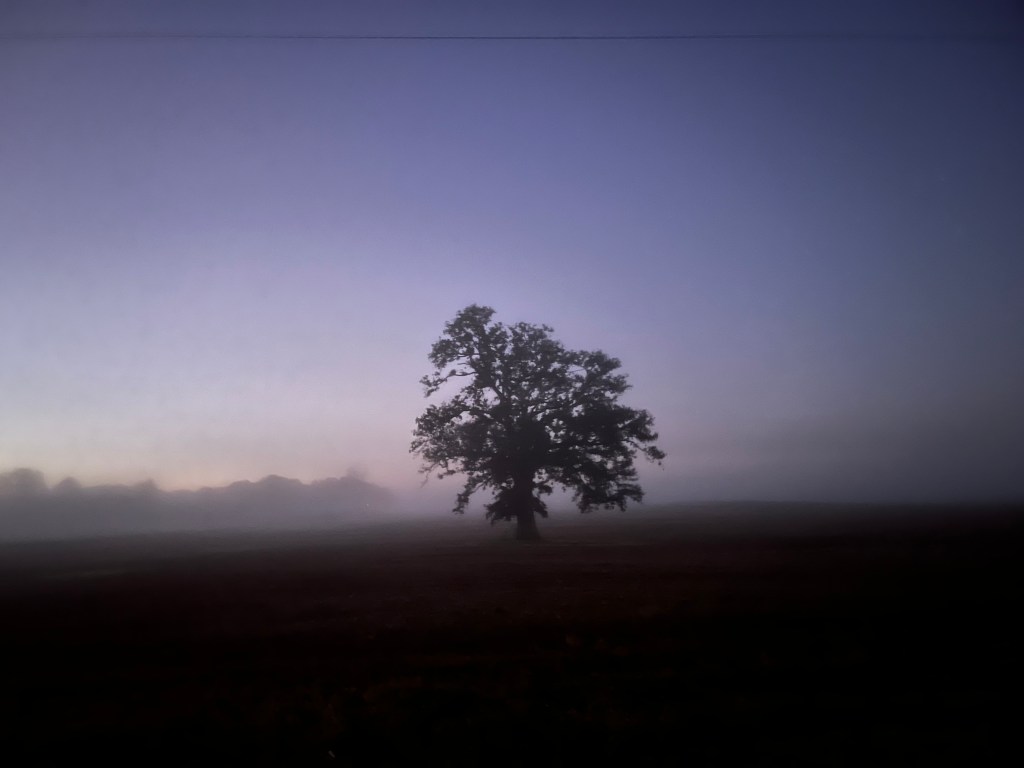
The other night as I made my sojourn home after what seemed like hours in traffic, I saw this lone oak tree out in the field. I’ve seen this tree standing there at that turn through every season year after year. It’s been the focus many photos . This particular night, however, it seemed to possess a different power. I felt like it was speaking directly to me about the Power of standing. Not just standing when you have all your ducks in a row or you think you’re at your best but standing just as tall under the cloak of darkness. Life often brings moments that feel like long nights—when the darkness seems overwhelming, and the weight of our struggles eclipses the light of our creative spirit. For those of us with unconventional careers—artists, writers, innovators—these nights can feel particularly heavy. Especially since we’re already navigating uncharted waters, relying on our passion, plans, and fortitude to stay afloat.

Recently, I was reminded of this when a dear friend, someone I consider a sister, faced the unimaginable loss of both her parents within a short time. These were people who not only shaped her life but also touched mine. They were pillars, guiding lights whose love and wisdom made the world feel more steady. In their absence, she could have crumbled under the weight of grief. But instead, I saw her stand—tall, unwavering, and deeply rooted in her truth. Her smile became the sunshine, the glow in dark times.

Watching her navigate this profound loss, I was struck by her resilience. She reminded me that standing in the night is not about denying the darkness. It’s about acknowledging it while refusing to let it extinguish your light. As creatives, we often find ourselves in similar moments. The rejection, the self-doubt, the financial uncertainty—they can all conspire to pull us into the shadows and choke out the power of our craft.

But here’s the lesson: the night is not the end. It’s a canvas. In those moments of darkness, you have a choice. You can retreat, or you can create. You can let the night silence you, or you can let it inspire you to speak louder. My friend chose to stand in her power, honoring her parents’ legacy by continuing to live fully, to love deeply, and to create meaning from her pain. For those of us pursuing paths that require risk, courage and creativity, we must do the same. We have to stand in the night. We have to create in spite of it—or perhaps because of it. Our art, our work, our very lives are testimonies to the fact that the night cannot last forever. Moreover, You’re never really alone, no matter how solitary you feel. You are rooted in the dreams and hopes of the ancestors, planted in this earth.

Remember that stars shine brightest in the darkest skies. So, when life feels heavy, remember this: your power and connection doesn’t vanish with the setting sun. It becomes a beacon, guiding you and others through the night. Stand tall. Stand firm. Stand in the night. And know that your light, no matter how dim it may feel, has the power to guide you home while illuminating the path for someone else. Keep creating. Keep believing. Keep standing.