We Are The Monuments…

We’ve all, at some point, walked past monuments built by others, honoring others. Why do we wait for someone else to honor our stories? What happens when we realize we are the monuments, the living, breathing proof of endurance, imagination, and grace? Our buildings aren’t just brick mortar, and glass. Our art is never just paint on a surface. They are evidence of belief and resolve that refused to fade. It’s the kind of creation that reminds us our presence is the monument, our work the foundation, and our progress the pedestal upon which our future stands.

Some Wise Dude


About a year or ago I got a call from a fella, telling me he needed a mural done on the FX Market on Pulaski Pike. Now, mind you, I used to get a lot of spam calls like that. So much so that I was advised to remove my phone number from my contact information. The gentleman on the other end was Vincent E Ford, serial entrepreneur working on a plethora of projects. He said he’d tried to reach me two years prior. We set a meeting and went from there. At our first meeting, I felt I knew him from somewhere. He tuned in to the familiarity, so we started climbing the family tree.  We did have some people in common but only by marriage. I came to know that he had a construction company, a flagging company, some housing developments, an event center in the works, and one other FX Market gas station before the one upon which he wanted the mural painted. For some reason, it didn’t take long for us to begin bantering like we were old friends. 

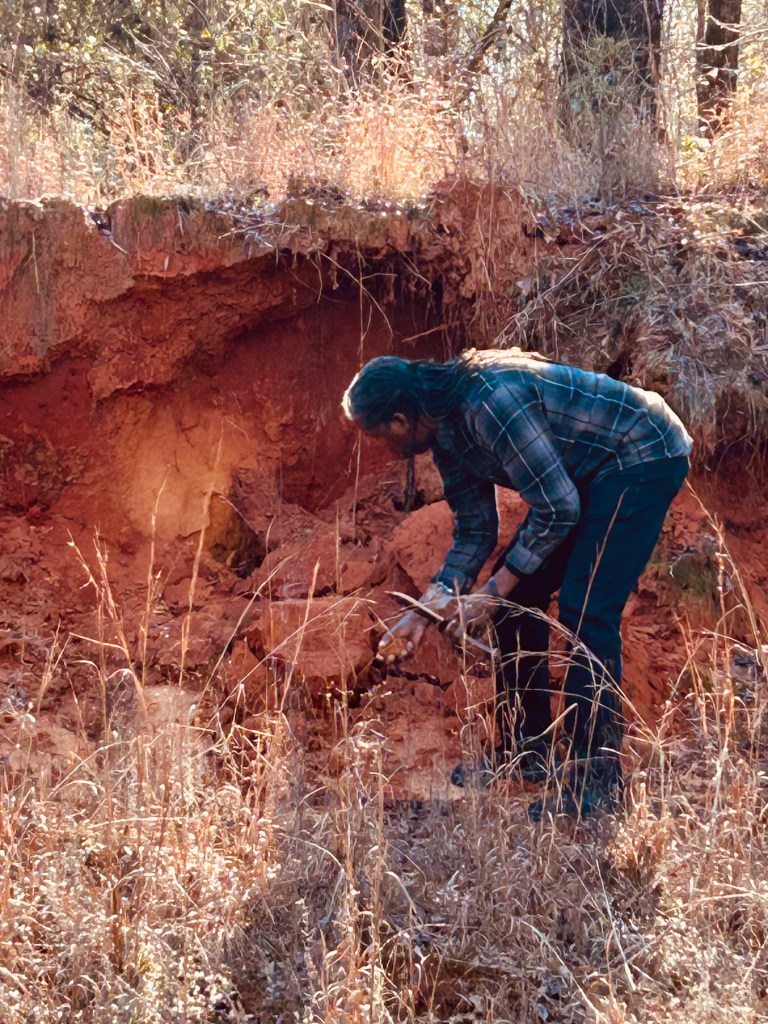
When he came through on the mural and shared his why, I felt better about the project. The subject matter was The Buffalo Soldiers, the U S 10th Cavalry Regiment that had camped on a hill near the FX Market site in the late 1800s because they were not allowed to stay with the white soldiers.  At first the idea of painting this on a gas station didn’t thrill me. After some consideration. I came to realize it was the best place. Besides, I’d already activated the land long before I knew who was doing something with it when I had exhumed red clay from the site.  This was people’s art and all types of people patronize gas stations. It wasn’t just about painting on a gas station, it’s creating legacy in so many ways. And this isn’t just a gas station; it’s a monument honoring monuments.

In the 1960s, according to local historians, there were at least four Black owned gas stations in the Huntsville/Madison County area. Currently, according to one study there are only four in the entire state of Alabama. Two are here in Huntsville/Madison County and Vincent Ford is the proprietor of them both. He had an idea, dreamed it up, and brought it to pass. At the end of the day, we all need gasoline, right. The first one he built is on family land in Harvest.  The other one (with the Buffalo Soldier mural) sits on Pulaski Pike across the street from Northwoods Public Housing Community where he grew up, and the namesake Historic Space after the Buffalo Soldiers, Cavalry Hill. It stands as a testament to belief beyond borders, and attitude determining altitude. What started as a request for paint on a wall between us became something bigger, a mirror held up to what’s possible when vision meets purpose. His gas stations aren’t just a business; they are a declaration that our stories belong in full color, on our own walls, in our own neighborhoods. A gentleman stopped and inquired about the FX Market gas station one day. He had heard it was Black owned. I affirmed. He smiled as he pulled off and said on repeat, “We comin’ up.” I felt his sense of pride and resolve echoed in the declaration. So if you’re reading this and haven’t gone by. Do so if for no one else but yourself. This is an investment in us. When we see what we can do, it gives us the inspiration to continue to do.

This is what happens when belief outlives circumstance. When we stop aiming for the idea of Black excellence and start setting the reality of a Black standard, where ownership, craftsmanship, and community care are the norm, not the exception. When we build, we build for generations to come. When we create, we create capacity. And when we pour into our own, the return is legacy. That mural isn’t just about art in public space. It’s about arrival. A reminder that we don’t just dream beyond our address, we redefine it.

More Than a Portrait

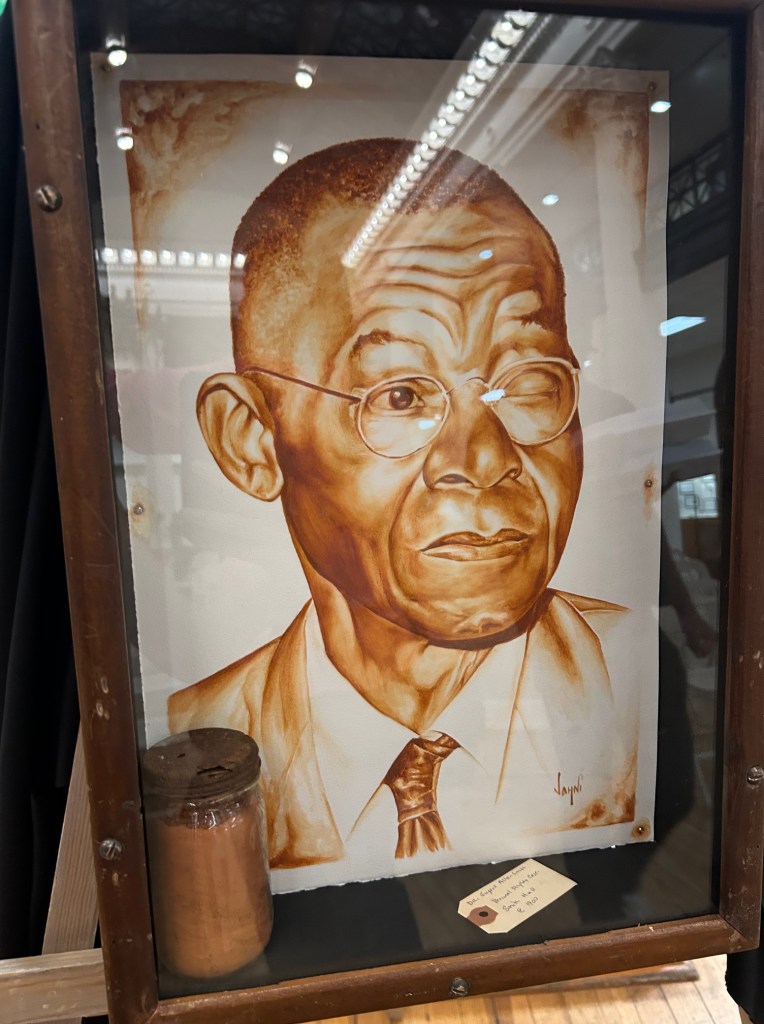
It was more than an honor to play a part in the resurrection of Jefferson Davis Jackson’s image and legacy. From the very first mention of this project, I sensed it was more than an artistic endeavor — it was a cosmic assignment, a sacred agreement between the seen and unseen, calling forth the spirit of a great man long buried beneath the weight of history’s silence. For 66 years beginning in the late 1800s, Jefferson Davis Jackson worked on the University of Alabama campus beginning at the tender age of 11 years old. Many of those years he labored alongside Dr. Eugene A. Smith, a professor and geologist invested in finding the natural resources that could be used to develop industry in the state following the ravages of the civil war. Jefferson Davis Jackson, a man devoted to life, wore many hats on campus and abroad. From custodial, to maintenance, to traveling by horse and buggy with Dr. Smith across the entirety of Alabama excavating and documenting the natural resources and history of the state.  From home to church, to work, he was all in. He worked in the very building, Smith Hall, where Autherine Lucy, the University of Alabama’s first Black student took classes. Was he there the day a shotgun blast blew a permanent scar to the outside of Smith Hall, or the day an Alabama governor made a diabolical declaration.  Somewhere along the way the name and legacy of J. D. Jackson were covered over by time, ignorance, and the order of the day. 

One day I received an email from a young woman working in the Museum of Natural science at the University of Alabama. It’s Alabama’s oldest natural science museum. I could feel the excitement through her appeal.  She had found a trail leading to the greatness of a Black man Named Jefferson Davis Jackson. She wanted me to do a red clay portrait of him. “I knew I had to contact you.” she said. “I knew you were the only one who could do this justice.”  Soon we spoke by phone and, feeling the tug of ancestral beckoning through my busy schedule, I agreed to do the portrait. I needed to walk the areas he walked, see the spaces he inhabited, speak to relatives, and gather earth from his walked pathways. Why did he start working at the university at age 11? How did he lose his eye? We scheduled a trip to Tuscaloosa and the journey began.

The process itself is ritual. I gathered red clay from the very soil of the campus of the University of Alabama. This time under the click of cameras and the gaze of assistants. The sacred ground is alive with memory, connecting my work to the land and its complex, often untold, narratives. The red clay, stained with the life-blood of our ancestors, holds within it both trauma and triumph — the iron-rich soil echoing the iron in human blood, linking us inextricably to those who came before. In its crimson grains, I feel the pulse of generations. Mother Earth knows their names. The clay is a portal, a living map. To this I added water from the nearby Warrior River. Water represents spirit. The river is a witness, a keeper of stories, a carrier of forgotten songs. Its waters hold the essence of what was lost and what still lingers. As clay and water met paper, each touch was more than technique. It was an invocation. The act of placing clay upon the surface became a merging of worlds, a thin place where past, present, and future blurred. I never work alone. Sometimes I feel like the ancestors are leaning in, guiding my hands, speaking through the vibration of the red earth. In this work Jefferson Davis Jackson was not just being rendered, but reawakened, his light called forth through the elements of earth and water, through the breath of spirit and artistic calling. 

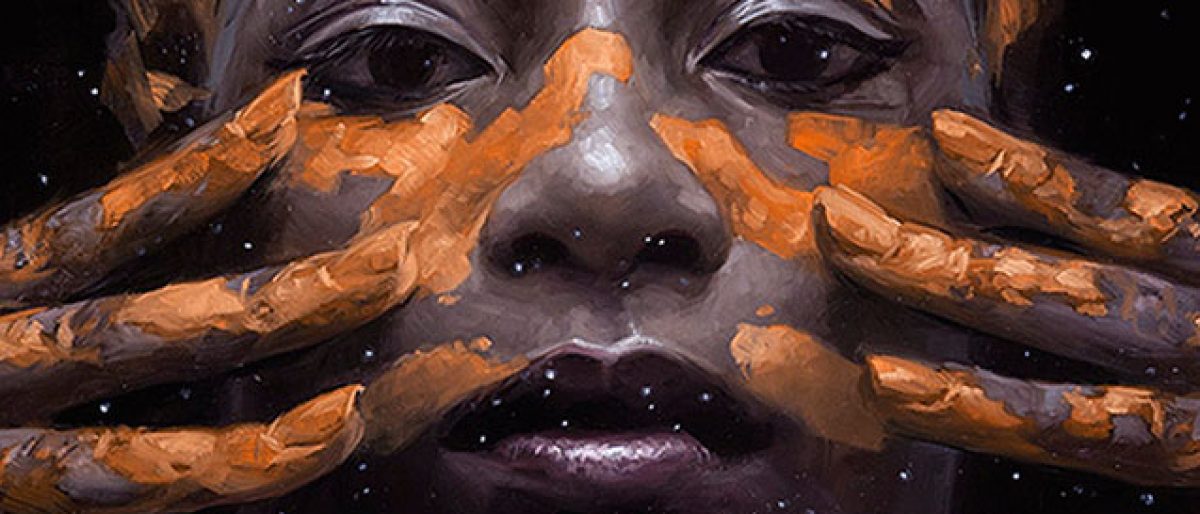
The portrait is a vessel — a bridge between dust and flesh, blood and starlight, past and future. The red clay tethers this work to this southern landscape and to the heavens. It affirms what we already know deep in our bones: that our stories cannot be erased. They may sleep beneath the soil, but they rise again through us, with us radiant and undeniable. In this artwork, Jackson stands not as a rendering or shadow of the past but as a resurrected star in the firmament of Black excellence, human nobility, a beacon for those yet to come. From his devotion to the university and his community to his baritone voice in the church choir, he was a man among men. This is not simply a painting—it is a ceremony. A cosmic reckoning. A testimony inscribed in earth and water, blood and memory. It is a conjuring, a return, a restoration. With hands deep in sacred soil, I summon legacy back into the light, returning one of our own to his rightful place among the honored. Let this work stand not only as tribute but as threshold. A portal. A vow. To this end—and this radiant beginning—there is more to come…

Constructing A Sentence

This past weekend, in Montgomery, AL I stood in the Legacy Museum and the National Memorial for Peace and Justice surrounded by the weight of history—our history. I saw the names, the chains, the terror written into law, the bodies strung from trees like strange fruit, the incarceration statistics. I felt the gravity of centuries of pain, and yet, what shook me just as deeply was not only what was behind us—but what is still wrapped tight around us.

Complicity – the quiet acceptance of injustice. Ignorance is not the act of not knowing, but the passive choice of ignoring. The refusal to confront truth. Consider the audacity of a system that still forces Black and Brown children to learn and thrive under the names of those who fought to keep their ancestors enslaved, and their descendants who don’t realize they lost (or did they?). I speak from a space of knowing, having once taught at Lee High School in Huntsville, Alabama. I walked those halls, labored in the classrooms, and looked into the eyes of those students—brilliant, gifted, filled with promise—and I asked myself the same question I ask today: How can they truly learn and be whole under the banner of their oppressor? Would the Jewish people require their children to attend a school named after Adolf Hitler? Would Germany even allow a school to be named after him? Would America ask Japanese American students to pledge allegiance in a school named after the architects of their internment? I would think not. Because we recognize that names carry weight. Names shape perception. Names have power.

Yet across Alabama, across the South, we still expect our children to sit in classrooms, to dream, to rise—while the very walls around them whisper, Know your place.This isn’t history. This is now. Schools named after Robert E. Lee, J.E.B. Stuart, and others weren’t built in the 1800s. No, they were erected in the heart of the 20th century, long after the Civil War, as a direct response to the Civil Rights Movement. These names were chosen with intention. They were planted like landmines, meant to remind us that while laws may change, power does not surrender easily. J.E.B. Stuart high school in Virginia has been renamed Justice High School. Lee High School, in what its said to be the most progressive city in Alabama, has survived every move to get the name changed. Perchance the mindset of those who put it in place is alive and well. The wish to hold the name and what it stands for seems more desirable than the true intent to move beyond. With that, I quote the words of Dr. Martin King, Jr. in his Letter From A Birmingham Jail, “Injustice anywhere is a threat to justice everywhere.

Some will always say, “It’s just a name.” But the truth is, names have always been tools of control. That’s why enslaved people had their names erased. That’s why schools, streets, and institutions were named to honor those who upheld white mental impoverishment (I do not use the term white supremacy on purpose as there is nothing supreme about it) . That’s why the fight to reclaim names, to rename spaces, is a battle for dignity and a strong nod toward justice. It is not enough to say we have moved past the inglorious past when it still creeps among us, etched in bronze, carved into stone, stitched onto letterman jackets, and typed on diplomas. A better nation is not one that simply acknowledges wrongs—it is one that corrects them. It’s past time for change. Rename the schools. Reposition the monuments to treason. Confront the truth, not for comfort, but for justice. Anything we are seeing in today’s climate – and we are seeing it, is a direct result of seeds planted…and nourished. If we are to truly move forward exemplifying an honorable legacy, we must cease laboring under the weight of those who chained us to the past.

The Earth Never Forgets

Late last year I had the honor of attending an Equal Justice Initiative and Community Remembrance Project posthumous memorial service and marker dedication for one Robert Mosley. In 1890 Robert Mosley was dragged away from life in Meridianville, Alabama, hung by an enraged mob of over 450 men. This southern son’s light was snuffed out in broad daylight. This act of homegrown terrorism was carried out not by the courts, but by self-appointed executioners, fueled by fear-based hatred and the presumption of guilt. Robert Mosley’s age was somewhere between 16 and 19. Basically a child.

I had the challenge and honor of doing a portrait of Mr Mosley in red clay which I gathered from the area of his murder. Working with red clay gives me the feeling of working with a living substance. It is, as a professor once told me, “rich with the blood of y(our) ancestors.” The red clay that forms this image is not merely pigment. It is a reminder of the blood shed on this southern landscape for what we now call home. This painting calls us to bear witness—not just to the life of Robert Moseley, but to the countless others whose names have been forgotten in the ashes of social violence.

During the ceremony, the photographer approached me about the portrait and his camera’s interaction with the eyes. He explained to me the sensitivity of his AI powered camera – how it could detect human eyes. He went on to say that it was reading the eyes of the portrait as human. I heard him but didn’t think anything of it. Several times more in passing he would comment on it, in obvious awe. Finally at the end of the ceremony when he was taking a photo of another gentleman and myself next to the piece, he came over shaking his head and said, “You’ve got to see this!” he proceeded to tell us that the camera had actually recognized the portrait’s eyes before it had ours. In the camera, I saw the green dots focused in on the eyes of the portrait of Robert Mosley. If I’d had another mindset, it could have come across as eerie. Obviously, to him it was rather fantastical and somewhat unbelievable.

At home that evening, I found myself looking through the photos of the program online. The words on the posterior of the marker read.

With his last words, Robert reportedly objected to the mob’s covering his face with a handkerchief, pleaded, “Let me see one more time in this world.”

As I read those words, a chill ran through me. Let me see one more time in this world. And here was this portrait—his likeness, his spirit—being recognized by an artificial eye meant only for the living. The thought settled deep in my chest. Had I, in some way, created a portal for his sight? Had the clay, the very earth itself, become a vessel for something beyond my understanding?

Sitting in the dim glow of my screen, I stared at the image—still seeing in my mind’s eye the green dots locked onto his eyes. It’s as if the camera, too, was acknowledging his presence. Maybe it was just technology behaving strangely. Or maybe, just maybe, Robert Mosley finally got the chance to see in this world one more time. After all, it is A.R.T. …A Resurrecting Truth.

UNBROKEN PARADOX

I am taking a departure from my normal and sharing a work of visual art. “Unbroken Paradox” honors the extraordinary life of William Hooper Councill, a former enslaved man among men who rose from the red dust of Alabama to become the founder and first president of what is now Alabama A&M University. This work, created with red clay taken from the grounds of his enslavement and the university he built, embodies the profound duality of his journey—pain and triumph, oppression and liberation, roots and ascension.

I was told by a professor while an undergrad at Alabama A&M University that “Your success is inevitable because this Alabama Red Clay is rich with the blood of your ancestors.” Those words transformed me from a witness to a man on and in purpose.  The red clay is more than a medium; it is history itself, rich with the essence of the land that bore witness to Councill’s transformation. From the soil of hardship grew a legacy of excellence, a paradox of unbroken spirit in the face of unimaginable adversity. This work connects past struggles to present victories, serving as a timeless reminder that greatness can emerge from even the harshest conditions.

“Unbroken Paradox” is a piece of history that celebrates the resilience, vision, and courage of one of Alabama’s greatest pioneers. It’s a testament to the power of education to uplift and transform lives, just as Councill did for countless others. This work is charged with the “blood” of our ancestors. “Unbroken Paradox” is not merely a painting; it is a legacy, a story of perseverance, and a beacon of inspiration for generations to come.

Curating Spaces

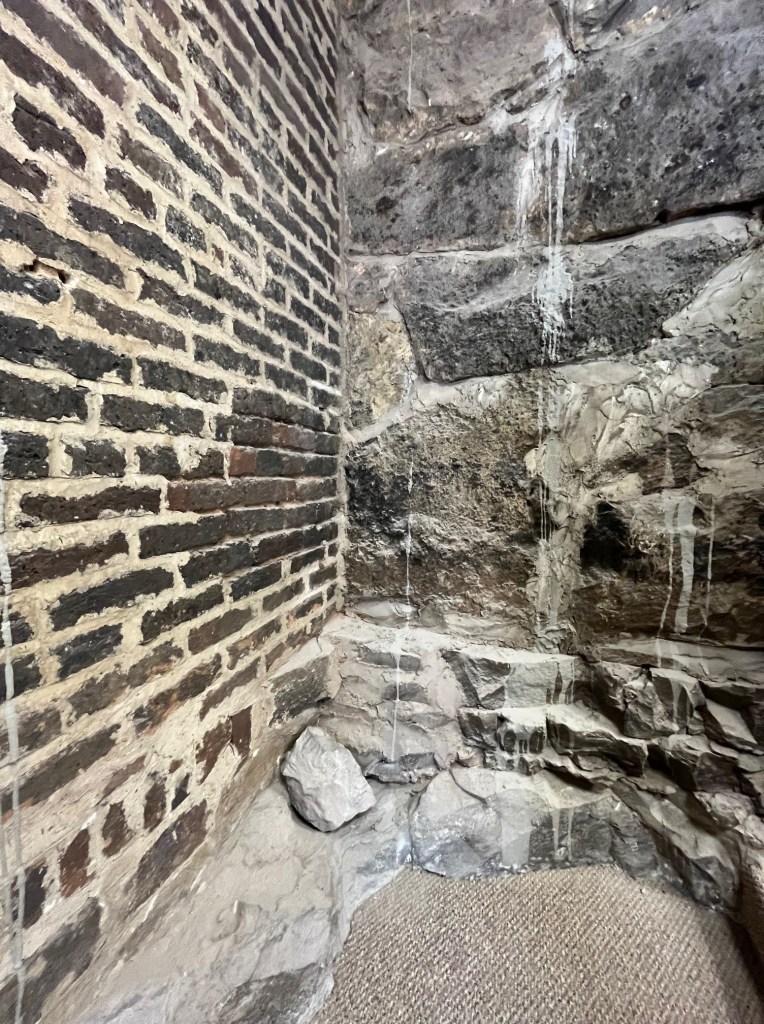
Curation is about much more than hanging art on walls or items in a collection—it’s about shaping environments that reflect our values, histories, and aspirations. As an artist, I recently completed a commission for the new City Hall, an institution of governance and civic pride. Yet, directly across the street, the basement of a former bank holds a darker legacy: it once imprisoned enslaved people, treating them as chattel collateral in its cold stony bowels. This stark contrast between spaces reminds us how intricately intertwined the present is with the past, and how our relationship with space has the power to elevate or diminish our humanity.

We are the curators of the spaces we inhabit—our homes, workplaces, public buildings, and the invisible spaces between us as human beings. For too long, access to these spaces, particularly those of influence and power, was denied to people based on race, class, or gender. Today, as we step into places where chosen sectors of society were forbidden, we carry a responsibility to reimagine and reshape them with intentionality. Whether we are conscious of it or not, we design the spaces that define us, deciding who gets to be seen, heard, and respected within them.

Curating space goes beyond physical walls; it’s also about the various interactions that shape our societies. How we treat one another in these spaces, the stories we honor, and the legacies we confront are all part of this curation. Just as we, as artists, choose what to display in a gallery, we choose what to elevate or omit in our life space as well. Spaces, after all, are more than just physical—they are emotional and symbolic. They carry the not so dead weight of history but also the potential for resurrection and transformation.

Today, as we gain access to spaces once closed to some by law, litany, or self-imposed limitation, we do so with the knowledge that we are responsible for more than just being there. We must curate them for ourselves and future generations, ensuring that the injustices of the past do not persist and walk among us in contemporary designer hoods. Every room we enter, every relationship we foster, and every piece of art we create becomes a part of that narrative—a reflection of how we choose to inhabit the world and bridge the spaces between us. The question is not just how we fill these spaces, but how we use them to uplift and honor those who came before, while making room for those yet to come.