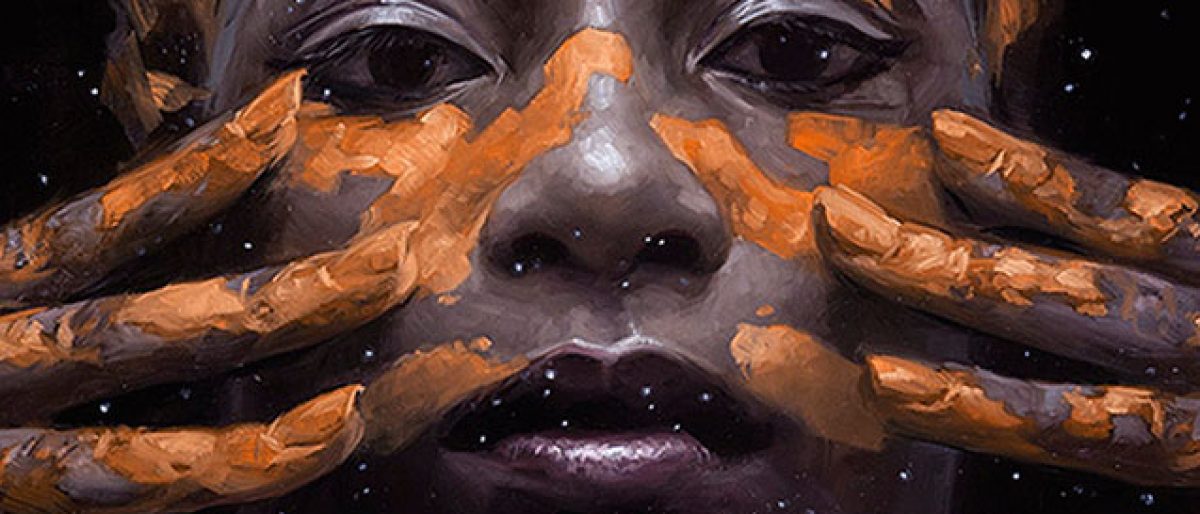
Reflection

I was recently painting a mural at an elementary school when the most inspiring thing happened. Not that inspiration isn’t flowing freely in an elementary school anyway. It was one of the last few days of the school year and energy was over the top. And boy do I remember those days. Plus it was a delayed day because of a previous night storm. A small group of teachers gathered in the Lunchroom for movie time for the children. Kindergarten through third grade piled in and planted themselves on the round stools at the tables, their attention supposedly glued to the big screen. Every so often, I’d pause from the strokes of my brush amid giggles and squeals, and glance back at the group and the show they were watching. Each time, I noticed one particular little fella—not watching the movie like the others—but watching me with intensity. Quiet. Still. Eyes locked in on my process.

He didn’t seem restless or antsy but focused. It wasn’t like he was distracted from the movie. I don’t think he had even started watching it. He was drawn—not to noise or the movie screen, but to the motion of my brush, the forming of images, The colors spreading on the wall, the unfolding progress of creation. To me, it was doing the thing I do. But to him it appeared to me magnetic. I couldn’t help but wonder what was going through his little head. Maybe he was in awe, mesmerized by this art thing. Maybe he saw himself. Maybe he recognized something familiar in the rhythm of the interplay of mind, spirit, passion, and whatever else makes us do what we do when we do it well. Maybe he thought I looked funny. But more than anything, what I realized is this: that used to be me, often silent but fiercely observant. Sometimes, the quietest gaze holds the loudest affirmation.

As a boy, I was captivated by the act of making, how things came to be. The why, who, when, where of the what. It drew me like a plant pulled toward the sunlight. I didn’t always have the language for it, but I knew I knew. There was something calling, beckoning. And now, all these years later, I find myself on the other side of that moment, being watched by a child whose heart might be whispering the same call. It reminded me that the work we do—especially the work born from intention, from purpose, from struggle and joy—echoes from the depths of life to the surface. It creates ripples. It becomes a mirror, a map, or a magnet for someone else.

That’s why it is imperative that we keep showing up. Not just for ourselves, but for the ones quietly watching, absorbing, being shaped by the vision of what’s possible. We are giving permission to the next artist. The next teacher. The next leader. The next dreamer. The next builder of worlds. What matters most doesn’t just leave a mark on walls, paper, stage, or film, —it leaves a reflection for and in those to come.
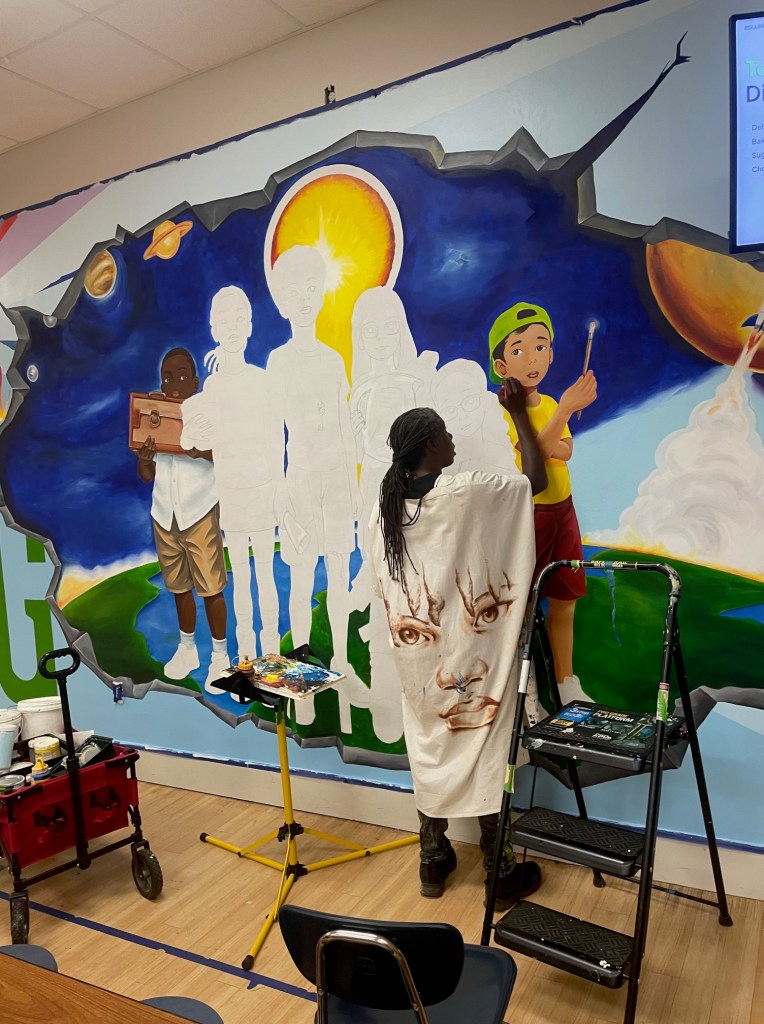
Photo by Michelle McClintock

Constructing A Sentence

This past weekend, in Montgomery, AL I stood in the Legacy Museum and the National Memorial for Peace and Justice surrounded by the weight of history—our history. I saw the names, the chains, the terror written into law, the bodies strung from trees like strange fruit, the incarceration statistics. I felt the gravity of centuries of pain, and yet, what shook me just as deeply was not only what was behind us—but what is still wrapped tight around us.

Complicity – the quiet acceptance of injustice. Ignorance is not the act of not knowing, but the passive choice of ignoring. The refusal to confront truth. Consider the audacity of a system that still forces Black and Brown children to learn and thrive under the names of those who fought to keep their ancestors enslaved, and their descendants who don’t realize they lost (or did they?). I speak from a space of knowing, having once taught at Lee High School in Huntsville, Alabama. I walked those halls, labored in the classrooms, and looked into the eyes of those students—brilliant, gifted, filled with promise—and I asked myself the same question I ask today: How can they truly learn and be whole under the banner of their oppressor? Would the Jewish people require their children to attend a school named after Adolf Hitler? Would Germany even allow a school to be named after him? Would America ask Japanese American students to pledge allegiance in a school named after the architects of their internment? I would think not. Because we recognize that names carry weight. Names shape perception. Names have power.

Yet across Alabama, across the South, we still expect our children to sit in classrooms, to dream, to rise—while the very walls around them whisper, Know your place.This isn’t history. This is now. Schools named after Robert E. Lee, J.E.B. Stuart, and others weren’t built in the 1800s. No, they were erected in the heart of the 20th century, long after the Civil War, as a direct response to the Civil Rights Movement. These names were chosen with intention. They were planted like landmines, meant to remind us that while laws may change, power does not surrender easily. J.E.B. Stuart high school in Virginia has been renamed Justice High School. Lee High School, in what its said to be the most progressive city in Alabama, has survived every move to get the name changed. Perchance the mindset of those who put it in place is alive and well. The wish to hold the name and what it stands for seems more desirable than the true intent to move beyond. With that, I quote the words of Dr. Martin King, Jr. in his Letter From A Birmingham Jail, “Injustice anywhere is a threat to justice everywhere.

Some will always say, “It’s just a name.” But the truth is, names have always been tools of control. That’s why enslaved people had their names erased. That’s why schools, streets, and institutions were named to honor those who upheld white mental impoverishment (I do not use the term white supremacy on purpose as there is nothing supreme about it) . That’s why the fight to reclaim names, to rename spaces, is a battle for dignity and a strong nod toward justice. It is not enough to say we have moved past the inglorious past when it still creeps among us, etched in bronze, carved into stone, stitched onto letterman jackets, and typed on diplomas. A better nation is not one that simply acknowledges wrongs—it is one that corrects them. It’s past time for change. Rename the schools. Reposition the monuments to treason. Confront the truth, not for comfort, but for justice. Anything we are seeing in today’s climate – and we are seeing it, is a direct result of seeds planted…and nourished. If we are to truly move forward exemplifying an honorable legacy, we must cease laboring under the weight of those who chained us to the past.

UNBROKEN PARADOX

I am taking a departure from my normal and sharing a work of visual art. “Unbroken Paradox” honors the extraordinary life of William Hooper Councill, a former enslaved man among men who rose from the red dust of Alabama to become the founder and first president of what is now Alabama A&M University. This work, created with red clay taken from the grounds of his enslavement and the university he built, embodies the profound duality of his journey—pain and triumph, oppression and liberation, roots and ascension.

I was told by a professor while an undergrad at Alabama A&M University that “Your success is inevitable because this Alabama Red Clay is rich with the blood of your ancestors.” Those words transformed me from a witness to a man on and in purpose.  The red clay is more than a medium; it is history itself, rich with the essence of the land that bore witness to Councill’s transformation. From the soil of hardship grew a legacy of excellence, a paradox of unbroken spirit in the face of unimaginable adversity. This work connects past struggles to present victories, serving as a timeless reminder that greatness can emerge from even the harshest conditions.

“Unbroken Paradox” is a piece of history that celebrates the resilience, vision, and courage of one of Alabama’s greatest pioneers. It’s a testament to the power of education to uplift and transform lives, just as Councill did for countless others. This work is charged with the “blood” of our ancestors. “Unbroken Paradox” is not merely a painting; it is a legacy, a story of perseverance, and a beacon of inspiration for generations to come.

And The GOAT Said To The Kid…Finale

I slept well for about 45minutes or so, got up, grabbed a bite to eat, and headed on out. The walk was only about a mile and some change to the Art Institute Auditorium from where I was living at the time. Right down in the loop, everything was pretty close. As I approached the building I saw the line to get in stretched to the corner. My anxiety kicked in. That was a long line and a lot of humans. What if I couldn’t get in? Would they run out of seats if I was at the end. I shushed the voices in my head and hit the back of the line. I was this close, yet it seemed so far. It was a bit too early for the line to move forward so it just grew, backwards.

Isn’t it crazy sometimes how when we get right up on what we say we want, the reverse gear feels so good in our hands. I’m thinking that may be a fear of success or our own light. Doubt starts creeping in like roots from some foreign species threatening to choke out our garden of dreams. Do something before they get too deep. Jar yourself outta that space however you have to. Action has a bit of magic in it. Looking around, I began to think about being inside the auditorium. Then a little voice in my head prompted me to head toward the door.

“Why…?” I countered. I couldn’t just go strolling past all these other people waiting in this stationary line. That would be rude. My Mama taught me better. Some had been there longer than me. Who was I to go traipsing to the front of the line? It was finally about time to go in. The line was still. If I moved, I couldn’t just reclaim my space again. “Excuse me, I had these big dreams but they didn’t work out. Could you let me cut line back in front of you?” If I left this safe space, it was all the way forward and in or all the way back. I peeled myself from my spot in line and began the walk toward the door. I could feel the yes on me. I didn’t stop ’til I was inside the double doors. The air was cool and inviting with no real smell. The low nap carpet muffled my footsteps. A woman walked over and asked if she could help me. I told her my name, and what the director had said. She turned, went to a table, came back and asked me to follow her. I was expecting to go to the door where people were gathered. Instead she lead me to a side door to our right away from the crowd. She pointed toward the front of the auditorium. “Anywhere down there if fine.”

“Anywhere..?” I repeated with a little disbelief and enthusiasm. “Anywhere.” She affirmed.

I stepped right down to the front row of the auditorium and sat down like I owned it. After taking in my surroundings, I called the friend and told her where I was in the auditorium. She couldn’t believe it. And to boot, the lady standing over me whose purse kept hitting my shoulder, was playwright and director, Cheryl Lynn Bruce – the wife of Kerry James Marshall. I stood up and joined the conversation, introducing myself like I was the speaker. We exchanged cards, had a laugh, and took our seats. I caught a glimpse of the other professor in the back; the one who told me there were no more tickets. My partner in crime soon joined me and we enjoyed the presentation to the fullest. A key message to the crowd, then to me specifically as KJM and I connected as Alabama native sons, was to continue and don’t be deterred.

Afterwards we chatted it up with Kerry James Marshall, Cheryl Lynn Bruce, and John White, son of Charles White. Our conversation lasted out the door into the tepid Chicago night air. The evening had gone even better than expected. Kerry’s words to me hit fertile ground. It was an honor to stand in the presence of an artist who has gained his level of accomplishment, holding true to his practice, and doing it on his message. I consider him the GOAT in that arena. He, in turn was taught and inspired by Charles White, a GOAT before him. It was one of those times when there was no doubt in my mind, what was possible, and where I am going. The kid eventually grows up. Stay the course, each step is a stroke toward your shine.