
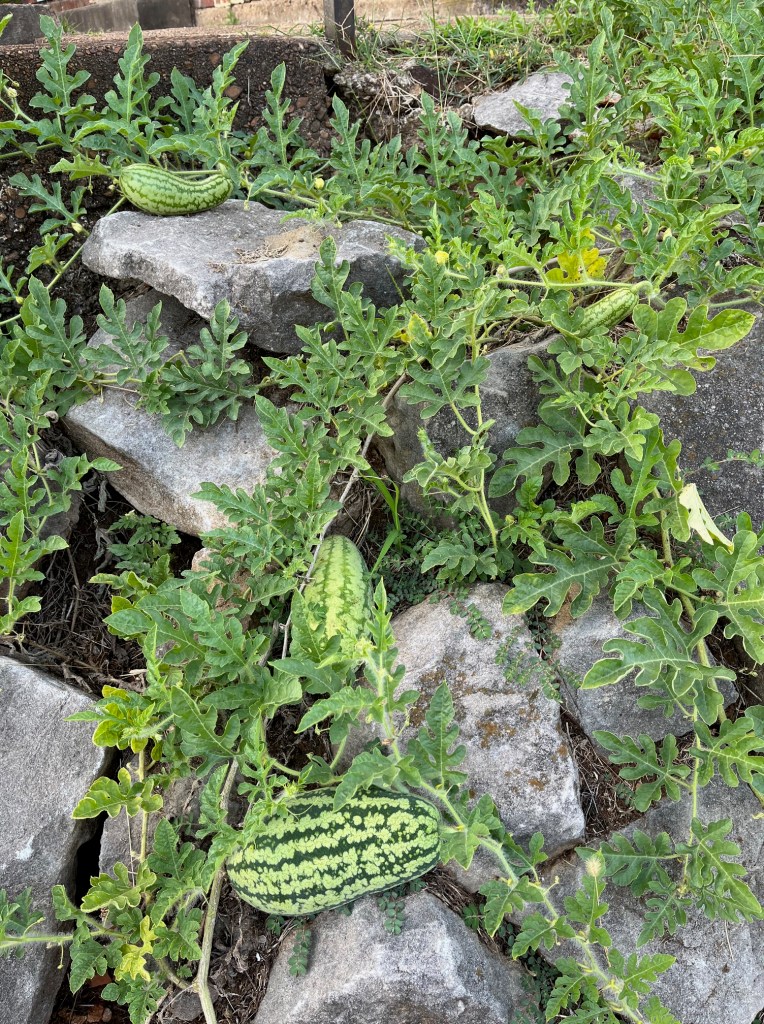
My studio is located in a transitioning neighborhood. With that come people who are transitioning – with some of them currently unhoused. I planted watermelons on the rocky terrace out front. Miraculously they grew like crazy. The fruit thrived in my alternative urban rock-strewn garden. I saw the project as an extension of what I do as an artist. This was both an installation and performance art. I would see people passing by and taking photos of the strange combination of watermelons and the wide open eyes that I had painted onto some of the rocks.
One of the purposes aside from my love of growing things was to have something to share with the neighborhood. Something organic in more ways than one. At the end of the visual feast there could be an actual one. As the succulent fruit began to mature, I started noticing that they also began their departure. Day by day I saw the watermelon patch grow a little more patchy. The neighborhood definitely understood the assignment. I took a sense of satisfaction and joy in the dual nature of my “project”.
Finally, there was one small melon left. A friend told me that if I wanted one I better go ahead and get it. Many had expressed their dismay that I didn’t get the opportunity to enjoy the fruit of my labor – that all of the melons had been stolen. I didn’t see it that way. I felt no anger or sense of violation. I think inherent in a creative person’s nature is to share. This may have negative consequences at times but our creative reserve is also heavily equipped for recovery. Sure it would have been nice to try one of the melons but the overall intention was coming to pass.
One evening, as I left, I eyed the last little melon tucked close to the steps. It did not look ripe at all but I knew if I didn’t get it, I wouldn’t have one at all. Putting my things in the car, I walked back over and plucked the little fella from its bed. When I got home, I gave it to my daughter to play with. She wrapped the little mellon a blanket and babied it for about a week.
One morning she came down with it and put it on the counter in the kitchen as she passed by. “I wonder if that thing is any good.” I said out loud. “You want to see? Her answer surprised me. I definitely thought she would be sentimental about it. A little while later we had a bowl full of deep red fully ripe-looking fruit. She volunteered to be the guinea pig. I let her without hesitation. Her first bite told me it was better than I thought it would be. I took a bite. It was ridiculously delicious. We almost ate the entire bowl but stopped ourselves to save some for the rest of the family.
I’d assumed the melon wouldn’t be ripe because of its size and since it had been carried around for a week or so. I was wrong on both accounts. That little melon carried a wealth of lessons. This whole thing showed me the benefit of sometimes letting go of ownership to embrace shared joy and community. Rather than feeling the need to guard what I grew, I saw the plants as art and a gift to the neighborhood. Generosity is its own reward. When the last melon, babied for a week, unexpectedly ripe and delicious was enjoyed together with my family, it served as a reminder that good things come not only from control but also from surrender. This experience tied the harmony between creating and sharing. Art is life and life is art, especially in moments when we allow others to fully partake in what we’ve cultivated.



 Notes of A Native Son