We Are The Monuments…

We’ve all, at some point, walked past monuments built by others, honoring others. Why do we wait for someone else to honor our stories? What happens when we realize we are the monuments, the living, breathing proof of endurance, imagination, and grace? Our buildings aren’t just brick mortar, and glass. Our art is never just paint on a surface. They are evidence of belief and resolve that refused to fade. It’s the kind of creation that reminds us our presence is the monument, our work the foundation, and our progress the pedestal upon which our future stands.

Some Wise Dude


About a year or ago I got a call from a fella, telling me he needed a mural done on the FX Market on Pulaski Pike. Now, mind you, I used to get a lot of spam calls like that. So much so that I was advised to remove my phone number from my contact information. The gentleman on the other end was Vincent E Ford, serial entrepreneur working on a plethora of projects. He said he’d tried to reach me two years prior. We set a meeting and went from there. At our first meeting, I felt I knew him from somewhere. He tuned in to the familiarity, so we started climbing the family tree.  We did have some people in common but only by marriage. I came to know that he had a construction company, a flagging company, some housing developments, an event center in the works, and one other FX Market gas station before the one upon which he wanted the mural painted. For some reason, it didn’t take long for us to begin bantering like we were old friends. 

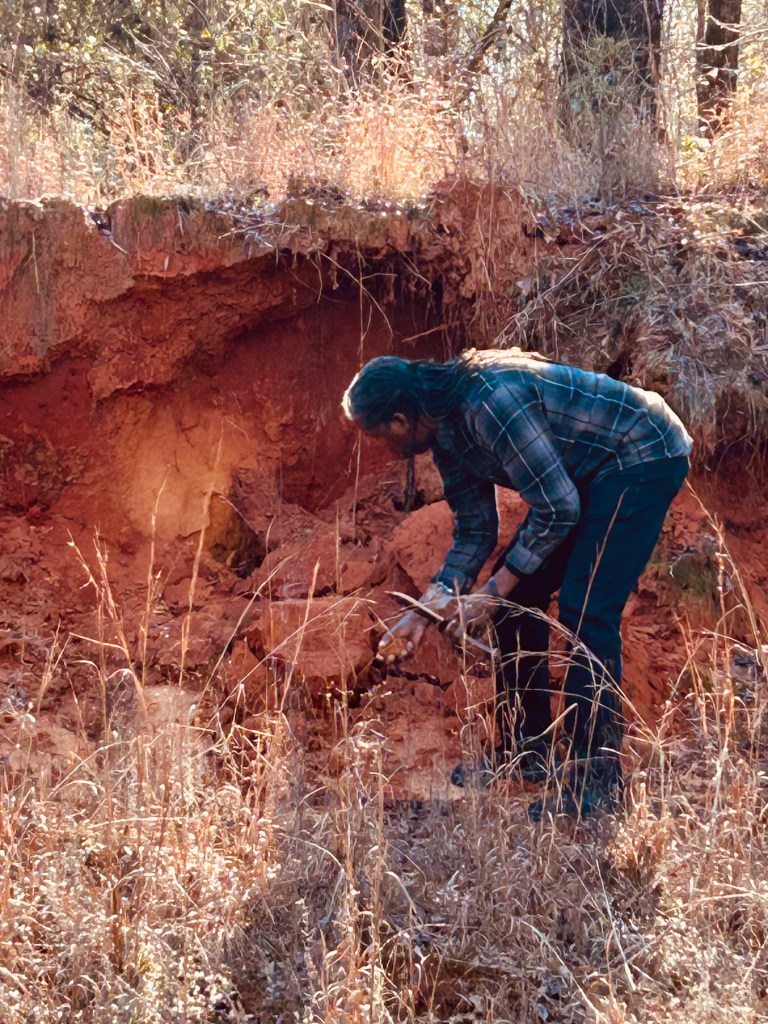
When he came through on the mural and shared his why, I felt better about the project. The subject matter was The Buffalo Soldiers, the U S 10th Cavalry Regiment that had camped on a hill near the FX Market site in the late 1800s because they were not allowed to stay with the white soldiers.  At first the idea of painting this on a gas station didn’t thrill me. After some consideration. I came to realize it was the best place. Besides, I’d already activated the land long before I knew who was doing something with it when I had exhumed red clay from the site.  This was people’s art and all types of people patronize gas stations. It wasn’t just about painting on a gas station, it’s creating legacy in so many ways. And this isn’t just a gas station; it’s a monument honoring monuments.

In the 1960s, according to local historians, there were at least four Black owned gas stations in the Huntsville/Madison County area. Currently, according to one study there are only four in the entire state of Alabama. Two are here in Huntsville/Madison County and Vincent Ford is the proprietor of them both. He had an idea, dreamed it up, and brought it to pass. At the end of the day, we all need gasoline, right. The first one he built is on family land in Harvest.  The other one (with the Buffalo Soldier mural) sits on Pulaski Pike across the street from Northwoods Public Housing Community where he grew up, and the namesake Historic Space after the Buffalo Soldiers, Cavalry Hill. It stands as a testament to belief beyond borders, and attitude determining altitude. What started as a request for paint on a wall between us became something bigger, a mirror held up to what’s possible when vision meets purpose. His gas stations aren’t just a business; they are a declaration that our stories belong in full color, on our own walls, in our own neighborhoods. A gentleman stopped and inquired about the FX Market gas station one day. He had heard it was Black owned. I affirmed. He smiled as he pulled off and said on repeat, “We comin’ up.” I felt his sense of pride and resolve echoed in the declaration. So if you’re reading this and haven’t gone by. Do so if for no one else but yourself. This is an investment in us. When we see what we can do, it gives us the inspiration to continue to do.

This is what happens when belief outlives circumstance. When we stop aiming for the idea of Black excellence and start setting the reality of a Black standard, where ownership, craftsmanship, and community care are the norm, not the exception. When we build, we build for generations to come. When we create, we create capacity. And when we pour into our own, the return is legacy. That mural isn’t just about art in public space. It’s about arrival. A reminder that we don’t just dream beyond our address, we redefine it.

Hills of Dreams: Becoming What We Needed to See

Sometimes the universe whispers before it speaks.

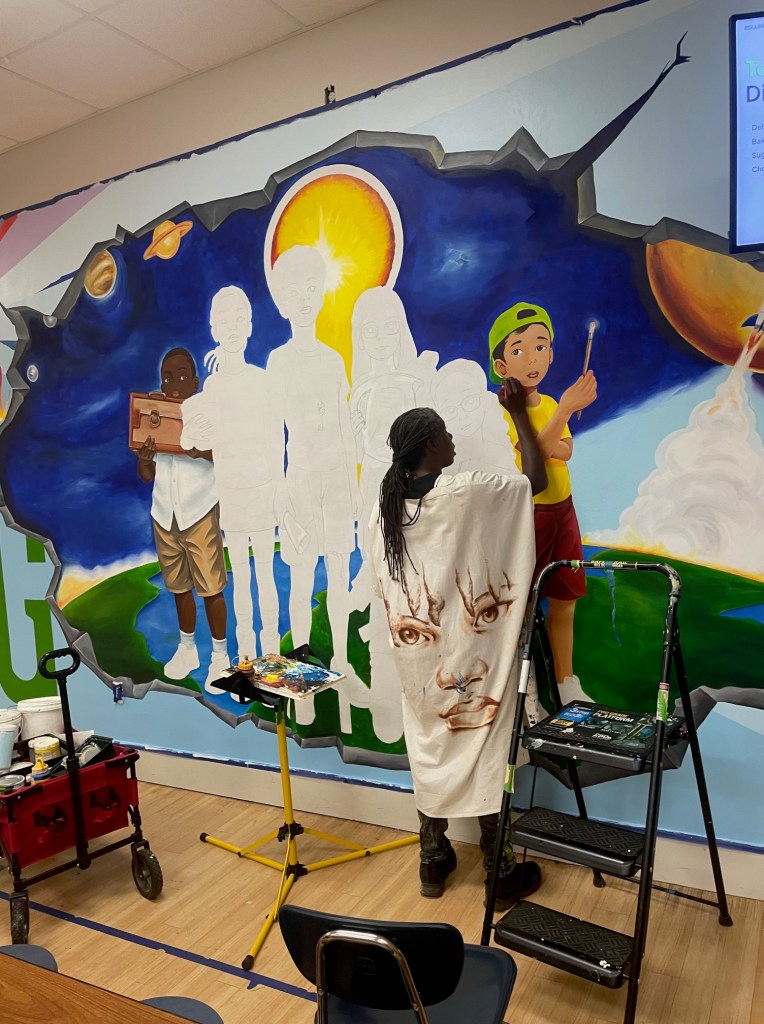
Not long ago, I had the idea that I wanted to do something for the elementary school I attended as a child. I considered doing a mural or workshop. It was an idea that I mentioned only to my wife and scribbled in my journal. The very next week, no joke, I opened an email from the art teacher at Rolling Hills Elementary School. Her enthusiasm came straight up outta that computer. She had seen my work and wanted me to paint a mural. She had the will and the zeal, but no true idea what it would take or cost to bring it to pass. But I already knew it was destined to be. We trusted the process. Huntsville City Schools and local sponsors answered the call and the project was set in motion. We would call the mural, Hills of Dreams.

With mixed feelings I returned to those linoleum floored cinderblock halls where my own journey began. Rolling Hills Elementary School was where I first discovered the joy of art making as a thing, the exhilaration of diving deep into the creative process, seeing my work on the walls for the very first time. Where I walked with reverence into that precious carpeted library that served as a keyhole to the worlds of my interests. Where I watched a popcorn seed planted in a baby food jar sitting in the window, sprout and reach for the sun. Where at the end of my fourth grade year, the teacher gave me my pick of books on the shelf by her desk. I felt like I bit off a little piece of heaven that day. At that little cozy elementary school tucked into northwest Huntsville, nestled on a hilltop, the foundation who I am as a creative was laid. To create there again, among students and teachers, was more than full circle. It was cosmic alignment.

One day, while I worked on the mural in the cafeteria, a group of students came in to watch a film. Out of curiosity, I glanced back at the screen then noticed a boy with his face toward me. He wasn’t watching the movie at all. His eyes were fixed on me as I painted. I could feel him watching. Deep, steady, unblinking. I turned back to my work, brushed paint onto the wall, and later looked again. He was still watching. Still locked in. Of course it didn’t bother me at all. People always ask whether it distracts me when they watch or talk to me when I am painting murals. The answer is no because I see mural painting as a type of performance art. Interaction with the audience is an integral part of the work.

In that moment, I wondered What was that little fella thinking? Was he seeing himself in me? Was I looking back at me at that age? I thought about how vital it is to live fully in my space, to be visibly present on my wings. Because oh, what it would have meant for me to have seen that when I was his age. To see possibility embodied, to see someone creating, to see myself reflected in real time. That’s what doing what I do is about. It isn’t just putting paint on walls or pen to paper. It’s about planting visions. It’s about representing and recreating for inspiration. It’s about adopting the responsibility to be what I once needed to see.

Every child deserves a light to reach toward. Adults can use it as well. So what do you say we commit or recommit to standing tall in our space, to showing up fully, to inspiring boldly for the ones watching us with wide eyes, waiting for their own wings to sprout. Because Hills of Dreams is not just my slinging paint on a lunchroom wall. It’s an embodiment, an incubator for what belongs to every child or person with a dream bigger than their circumstances. It’s for all of us who dare to go for the dream and to forge trails for others to follow. In fact , as I consider it all, I think I’ve been dreaming too small.

Reflection

I was recently painting a mural at an elementary school when the most inspiring thing happened. Not that inspiration isn’t flowing freely in an elementary school anyway. It was one of the last few days of the school year and energy was over the top. And boy do I remember those days. Plus it was a delayed day because of a previous night storm. A small group of teachers gathered in the Lunchroom for movie time for the children. Kindergarten through third grade piled in and planted themselves on the round stools at the tables, their attention supposedly glued to the big screen. Every so often, I’d pause from the strokes of my brush amid giggles and squeals, and glance back at the group and the show they were watching. Each time, I noticed one particular little fella—not watching the movie like the others—but watching me with intensity. Quiet. Still. Eyes locked in on my process.

He didn’t seem restless or antsy but focused. It wasn’t like he was distracted from the movie. I don’t think he had even started watching it. He was drawn—not to noise or the movie screen, but to the motion of my brush, the forming of images, The colors spreading on the wall, the unfolding progress of creation. To me, it was doing the thing I do. But to him it appeared to me magnetic. I couldn’t help but wonder what was going through his little head. Maybe he was in awe, mesmerized by this art thing. Maybe he saw himself. Maybe he recognized something familiar in the rhythm of the interplay of mind, spirit, passion, and whatever else makes us do what we do when we do it well. Maybe he thought I looked funny. But more than anything, what I realized is this: that used to be me, often silent but fiercely observant. Sometimes, the quietest gaze holds the loudest affirmation.

As a boy, I was captivated by the act of making, how things came to be. The why, who, when, where of the what. It drew me like a plant pulled toward the sunlight. I didn’t always have the language for it, but I knew I knew. There was something calling, beckoning. And now, all these years later, I find myself on the other side of that moment, being watched by a child whose heart might be whispering the same call. It reminded me that the work we do—especially the work born from intention, from purpose, from struggle and joy—echoes from the depths of life to the surface. It creates ripples. It becomes a mirror, a map, or a magnet for someone else.

That’s why it is imperative that we keep showing up. Not just for ourselves, but for the ones quietly watching, absorbing, being shaped by the vision of what’s possible. We are giving permission to the next artist. The next teacher. The next leader. The next dreamer. The next builder of worlds. What matters most doesn’t just leave a mark on walls, paper, stage, or film, —it leaves a reflection for and in those to come.

Photo by Michelle McClintock

More Than a Portrait

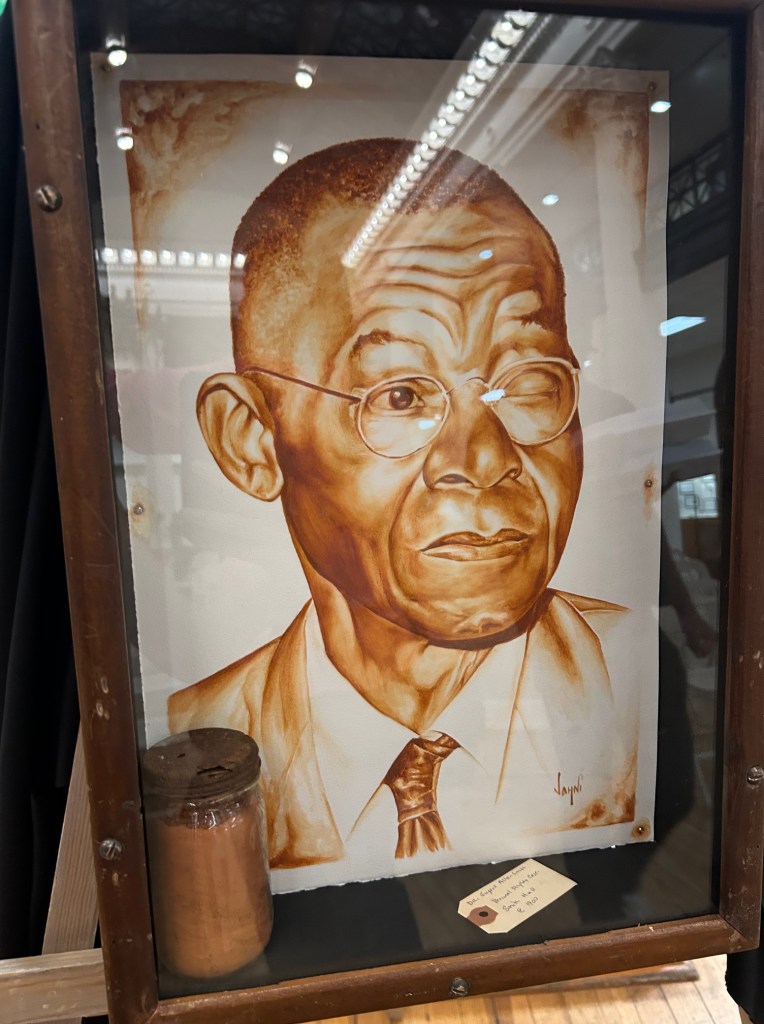
It was more than an honor to play a part in the resurrection of Jefferson Davis Jackson’s image and legacy. From the very first mention of this project, I sensed it was more than an artistic endeavor — it was a cosmic assignment, a sacred agreement between the seen and unseen, calling forth the spirit of a great man long buried beneath the weight of history’s silence. For 66 years beginning in the late 1800s, Jefferson Davis Jackson worked on the University of Alabama campus beginning at the tender age of 11 years old. Many of those years he labored alongside Dr. Eugene A. Smith, a professor and geologist invested in finding the natural resources that could be used to develop industry in the state following the ravages of the civil war. Jefferson Davis Jackson, a man devoted to life, wore many hats on campus and abroad. From custodial, to maintenance, to traveling by horse and buggy with Dr. Smith across the entirety of Alabama excavating and documenting the natural resources and history of the state.  From home to church, to work, he was all in. He worked in the very building, Smith Hall, where Autherine Lucy, the University of Alabama’s first Black student took classes. Was he there the day a shotgun blast blew a permanent scar to the outside of Smith Hall, or the day an Alabama governor made a diabolical declaration.  Somewhere along the way the name and legacy of J. D. Jackson were covered over by time, ignorance, and the order of the day. 

One day I received an email from a young woman working in the Museum of Natural science at the University of Alabama. It’s Alabama’s oldest natural science museum. I could feel the excitement through her appeal.  She had found a trail leading to the greatness of a Black man Named Jefferson Davis Jackson. She wanted me to do a red clay portrait of him. “I knew I had to contact you.” she said. “I knew you were the only one who could do this justice.”  Soon we spoke by phone and, feeling the tug of ancestral beckoning through my busy schedule, I agreed to do the portrait. I needed to walk the areas he walked, see the spaces he inhabited, speak to relatives, and gather earth from his walked pathways. Why did he start working at the university at age 11? How did he lose his eye? We scheduled a trip to Tuscaloosa and the journey began.

The process itself is ritual. I gathered red clay from the very soil of the campus of the University of Alabama. This time under the click of cameras and the gaze of assistants. The sacred ground is alive with memory, connecting my work to the land and its complex, often untold, narratives. The red clay, stained with the life-blood of our ancestors, holds within it both trauma and triumph — the iron-rich soil echoing the iron in human blood, linking us inextricably to those who came before. In its crimson grains, I feel the pulse of generations. Mother Earth knows their names. The clay is a portal, a living map. To this I added water from the nearby Warrior River. Water represents spirit. The river is a witness, a keeper of stories, a carrier of forgotten songs. Its waters hold the essence of what was lost and what still lingers. As clay and water met paper, each touch was more than technique. It was an invocation. The act of placing clay upon the surface became a merging of worlds, a thin place where past, present, and future blurred. I never work alone. Sometimes I feel like the ancestors are leaning in, guiding my hands, speaking through the vibration of the red earth. In this work Jefferson Davis Jackson was not just being rendered, but reawakened, his light called forth through the elements of earth and water, through the breath of spirit and artistic calling. 

The portrait is a vessel — a bridge between dust and flesh, blood and starlight, past and future. The red clay tethers this work to this southern landscape and to the heavens. It affirms what we already know deep in our bones: that our stories cannot be erased. They may sleep beneath the soil, but they rise again through us, with us radiant and undeniable. In this artwork, Jackson stands not as a rendering or shadow of the past but as a resurrected star in the firmament of Black excellence, human nobility, a beacon for those yet to come. From his devotion to the university and his community to his baritone voice in the church choir, he was a man among men. This is not simply a painting—it is a ceremony. A cosmic reckoning. A testimony inscribed in earth and water, blood and memory. It is a conjuring, a return, a restoration. With hands deep in sacred soil, I summon legacy back into the light, returning one of our own to his rightful place among the honored. Let this work stand not only as tribute but as threshold. A portal. A vow. To this end—and this radiant beginning—there is more to come…

The Earth Never Forgets

Late last year I had the honor of attending an Equal Justice Initiative and Community Remembrance Project posthumous memorial service and marker dedication for one Robert Mosley. In 1890 Robert Mosley was dragged away from life in Meridianville, Alabama, hung by an enraged mob of over 450 men. This southern son’s light was snuffed out in broad daylight. This act of homegrown terrorism was carried out not by the courts, but by self-appointed executioners, fueled by fear-based hatred and the presumption of guilt. Robert Mosley’s age was somewhere between 16 and 19. Basically a child.

I had the challenge and honor of doing a portrait of Mr Mosley in red clay which I gathered from the area of his murder. Working with red clay gives me the feeling of working with a living substance. It is, as a professor once told me, “rich with the blood of y(our) ancestors.” The red clay that forms this image is not merely pigment. It is a reminder of the blood shed on this southern landscape for what we now call home. This painting calls us to bear witness—not just to the life of Robert Moseley, but to the countless others whose names have been forgotten in the ashes of social violence.

During the ceremony, the photographer approached me about the portrait and his camera’s interaction with the eyes. He explained to me the sensitivity of his AI powered camera – how it could detect human eyes. He went on to say that it was reading the eyes of the portrait as human. I heard him but didn’t think anything of it. Several times more in passing he would comment on it, in obvious awe. Finally at the end of the ceremony when he was taking a photo of another gentleman and myself next to the piece, he came over shaking his head and said, “You’ve got to see this!” he proceeded to tell us that the camera had actually recognized the portrait’s eyes before it had ours. In the camera, I saw the green dots focused in on the eyes of the portrait of Robert Mosley. If I’d had another mindset, it could have come across as eerie. Obviously, to him it was rather fantastical and somewhat unbelievable.

At home that evening, I found myself looking through the photos of the program online. The words on the posterior of the marker read.

With his last words, Robert reportedly objected to the mob’s covering his face with a handkerchief, pleaded, “Let me see one more time in this world.”

As I read those words, a chill ran through me. Let me see one more time in this world. And here was this portrait—his likeness, his spirit—being recognized by an artificial eye meant only for the living. The thought settled deep in my chest. Had I, in some way, created a portal for his sight? Had the clay, the very earth itself, become a vessel for something beyond my understanding?

Sitting in the dim glow of my screen, I stared at the image—still seeing in my mind’s eye the green dots locked onto his eyes. It’s as if the camera, too, was acknowledging his presence. Maybe it was just technology behaving strangely. Or maybe, just maybe, Robert Mosley finally got the chance to see in this world one more time. After all, it is A.R.T. …A Resurrecting Truth.

A Timely Investment

As an artist, my life revolves around the creation of beauty and meaning. I pour a part of me into each stroke of my brushes, mark of my pen or pencil, and every conceptual decision. Art is timeless. But ironically, the pursuit of creation can sometimes make me lose sight of something even more precious than creativity: the value of time itself.

Time, unlike money, is a finite resource. No matter how much money we earn or what we achieve, we cannot stretch the hours in a day or rewind the clock to recapture moments we’ve missed. As a family man this reality hits close to home. Especially when my daughter walks across the room and I see that she’s a foot taller than she was two days prior. Sometimes she will ask whether I have to go to work that day. Of course my answer is always yes. But will I really remember that I missed that day off work just to hang out with her? While I strive to honor deadlines and push boundaries in my practice, I’ve had to confront the moments when my family and friends—the people who ground me most—felt sidelined by my work.

The truth is, you can always create more wealth in terms of dollars. A new commission, an additional workshop, or even a clever pivot to monetize your creative skills can generate the flow. But no amount of money can bring back any of my children’s first laugh or bike ride, an easy like Sunday morning with loved ones, or the quiet joy of simply being present for the people who matter most.

As an artist, my work is rooted in storytelling and legacy—in capturing essential moments that transcend time. But if I neglect the life around me, I’m failing to honor the very inspiration behind my work – my why. Art imitates life, and life is richest when we’re fully present in it. Yes, that may be a challenge to do but it is doable.

I’m still learning and yearning to embrace a feasible balance. That balance may never be evenly distributed. Some days, it may mean saying no to a project that doesn’t align with my core values or stepping away from my studio at a reasonable hour… to stay later another evening. Other days, it’s finding ways to integrate my family into my creative process, allowing my daughter to paint alongside me or sharing my vision with loved ones. These moments remind me why I do what I do in the first place.

For anyone struggling in the balancing of work and family, particularly in creative fields where the demands can be unpredictable, I encourage you to reflect on what truly drives you. Our success is not solely defined by accolades or financial milestones. It’s about the quality of your relationships, the memories you build, and the integrity you bring to your life and work. Really, time is the most valuable currency. Let’s invest it equitable with those who inspire us and for the moments that matter most.

Generating Light

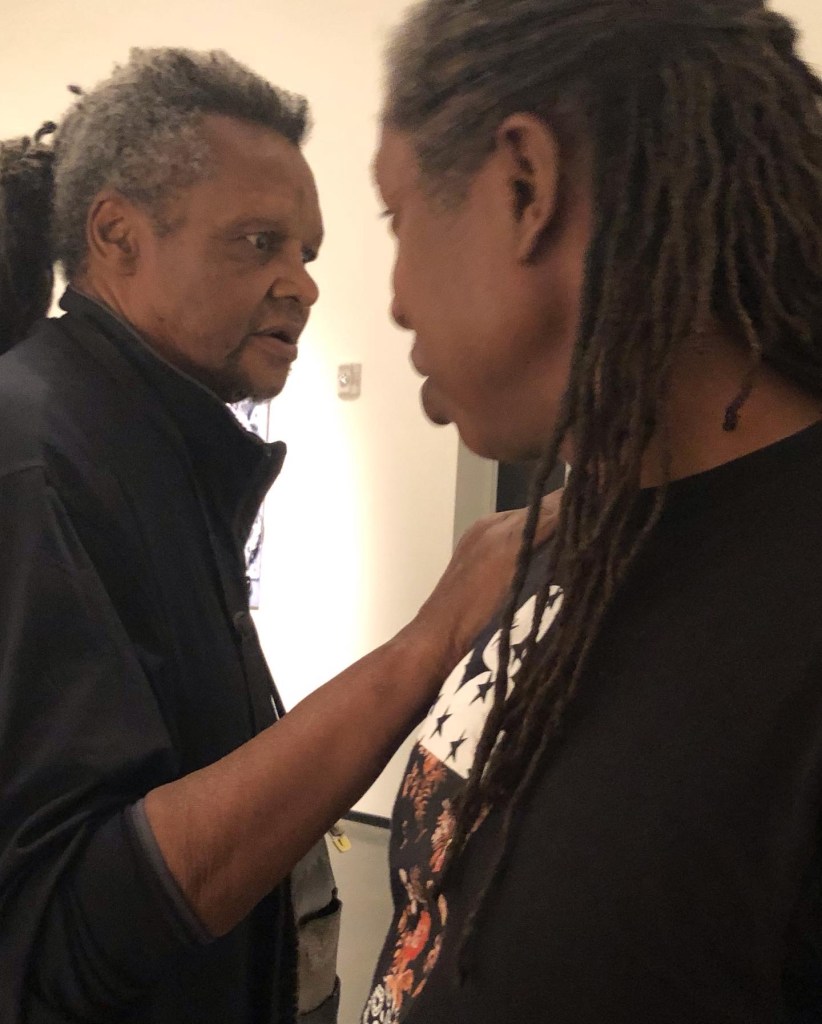
Some time ago, I traveled to see a Thornton Dial art exhibit. Although Thornton Dial has transitioned, his work lives on as a beacon of his presence here on the planet. As a fellow Alabama artist, I am inspired by his journey. Included on the panel discussion was Lonnie Holley, another southern artist I deeply admire. It’s very important for me and my practice to seek out those whose work/life have shaped my creative journey and pushed my vision forward. As I stepped up in line and began to speak with Lonnie, I noticed another young man waiting eagerly. Lonnie continued on and conversed with me longer than any of the others before. Having been in the position of one who has stood in the space of waiting and of greeting, I wanted to be respectful of both positions.

Not wanting to take up much more than my share of his time, I decided to step back and give the waiting young man his turn. He stepped up directly to me still smiling. With an animated look of controlled excitement on his face he said, reaching out his hand, “I was waiting to to meet you.” I was a bit surprised to say the least. It felt like time paused for a moment. I had come to seek wisdom and inspiration from someone I looked up to, only to be reminded that I too, am a light for someone else.

The moment revealed to me an ever present truth: we are all torches in someone’s darkness, a lamp in another’s searching, or simple a light along their pathway. While we are busy seeking illumination to guide our own path, we are generating light that illuminates the paths of others. It’s humbling to think about the ripple effect of our actions. Every brushstroke, every step forward or back, every story we tell holds the potential to inspire someone we may never meet. Whether you’re an artist, a teacher, a parent, or simply a person striving to grow, your journey is leaving trails of light for others to follow.

I believe this is what creativity and ultimately humanity are about—connection. We are a collective constellation, each star adding brilliance to the night sky. The world doesn’t just need one blazing sun; it needs the combined glow of every light bearer sharing their radiance. Keep shining, I say. Keep creating. Keep living authentically or at least pushing toward it. You never know who might be waiting to meet you, or who might already be watching and drawing strength from your light. We are all part of this dynamic, magnanimous, cosmic exchange of inspiration. When we create and share, we generate light—not just for ourselves, but for a world so in need of it.

A Call To Action

A month or so ago, I left a couple of pairs of shoes outside my studio. They were still in good condition butI knew I didn’t really need them anymore. I’ve cultivated the habit of passing along items I don’t use much—things I think might benefit someone else more—whether it’s clothing, shoes, or other belongings that could have a more useful life. I refer to it as blessing someone else with it. So, I marked the shoes “Free to You” and set them out for anyone who might need them.

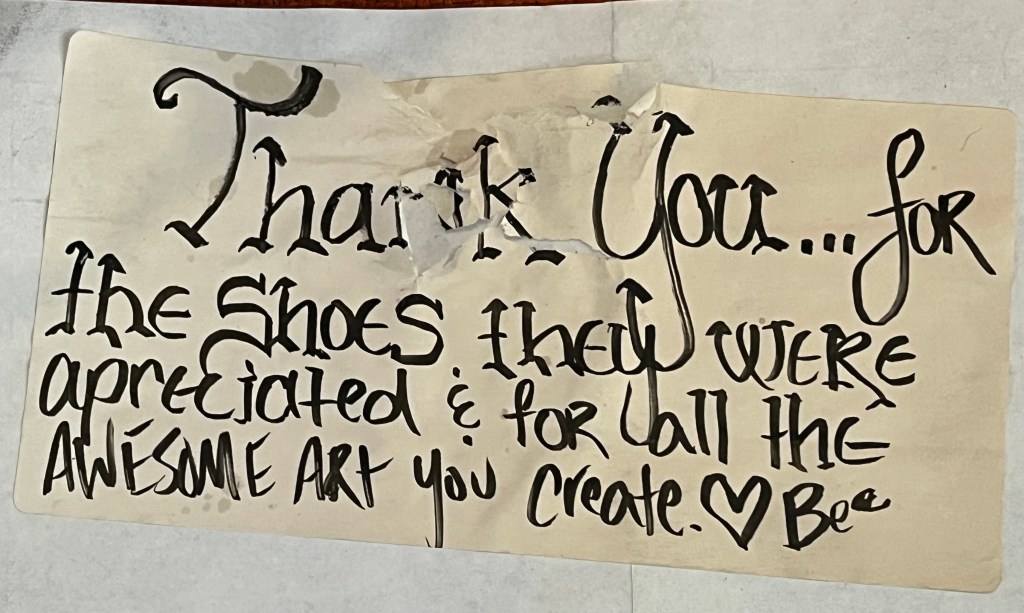
The next day there was a note on my door. It was short, but it carried with it a weight of gratitude and recognition that gripped my heart. It was a reminder of the deeper impact we can have on others, often in ways we don’t even anticipate. And I must mention, it was beautifully written.

Truly, I was moved by the thank you the shoes. That they were needed, and that the person who received them was grateful. But what hit me even harder was the second part: the recognition of and gratitude for my art . I have no idea where they may have seen my work – on the news, in a magazine, or a local mural. Either way, it had touched them. In the midst of what appears to be a struggle—of living without a home—this person could still see the value of what I create. In their own way they were affirming that my work matters, that it reaches beyond just an audience of people who walk through my studio doors, gather in suits and dresses in hallowed halls, and touches unexpected lives in unexpected ways. In that moment, I was reminded of the unique power of art. We often talk about art as something that reflects society or speaks to our times, but I also know art has the ability to transform us, to bridge divides and transcend barriers. To speak to the human condition, in whatever form it may take.

For this person, my art practice is not a distant or abstract concept. It wasn’t just something I put on a canvas or created in my studio. My art was seen, appreciated, and connected to an act of kindness—a simple gesture of sharing something as basic as shoes. They had, in turn, extended a gesture of kindness back, not just in thanking me, but in acknowledging the value of what I do as an artist. This experience has made me think a lot about how we can all intentionally contribute to the world, in big and small ways. Whether it’s through a work of art, a service rendered, a loaf or bread baked or bought, a pair of shoes, or a kind word, we all have the power to make a difference. And sometimes, it’s the smallest gestures that have the most profound impact.

We live in a world where it can often feel overwhelming to think about how we can truly make impact. But it takes every stroke to make the masterpiece. If you have things you no longer need or use consistently, consider blessing someone else with it. It could be something as basic as shoes, clothes, food, or even a bit of your time. And, for creatives, it’s a reminder that what we create has value far beyond the walls of our studios, labs, workshops, or galleries. Our work can touch lives in ways we may never fully understand. Creativity is a powerful tool for connection, and sometimes, it’s the unspoken messages that resonate the most. Let’s remember that what we give—whether it’s material goods or the fruits of our creativity—can make someone’s day, or even extend a life, reminding them they matter, lifting their spirits when they least expect it. So, the next time you come across something that could be useful to someone else, or you feel compelled to share a piece of your heart through your art, go for it. Bless someone with it. In the blessing you are blessed. You never know what impact your act of kindness might have, or how it might be received by someone who needs it most.

Thank you to the person who left that note. You reminded me of why I do what I do. And to everyone reading this: take a moment today to pass along something you can part with. It may be of much more value to someone else. You just might touch a life in ways you never imagined. Bless someone. I dare you…

UNBROKEN PARADOX

I am taking a departure from my normal and sharing a work of visual art. “Unbroken Paradox” honors the extraordinary life of William Hooper Councill, a former enslaved man among men who rose from the red dust of Alabama to become the founder and first president of what is now Alabama A&M University. This work, created with red clay taken from the grounds of his enslavement and the university he built, embodies the profound duality of his journey—pain and triumph, oppression and liberation, roots and ascension.

I was told by a professor while an undergrad at Alabama A&M University that “Your success is inevitable because this Alabama Red Clay is rich with the blood of your ancestors.” Those words transformed me from a witness to a man on and in purpose.  The red clay is more than a medium; it is history itself, rich with the essence of the land that bore witness to Councill’s transformation. From the soil of hardship grew a legacy of excellence, a paradox of unbroken spirit in the face of unimaginable adversity. This work connects past struggles to present victories, serving as a timeless reminder that greatness can emerge from even the harshest conditions.

“Unbroken Paradox” is a piece of history that celebrates the resilience, vision, and courage of one of Alabama’s greatest pioneers. It’s a testament to the power of education to uplift and transform lives, just as Councill did for countless others. This work is charged with the “blood” of our ancestors. “Unbroken Paradox” is not merely a painting; it is a legacy, a story of perseverance, and a beacon of inspiration for generations to come.

The Art of Letting Grow

My studio is located in a transitioning neighborhood. With that come people who are transitioning – with some of them currently unhoused. I planted watermelons on the rocky terrace out front. Miraculously they grew like crazy. The fruit thrived in my alternative urban rock-strewn garden. I saw the project as an extension of what I do as an artist. This was both an installation and performance art. I would see people passing by and taking photos of the strange combination of watermelons and the wide open eyes that I had painted onto some of the rocks.

One of the purposes aside from my love of growing things was to have something to share with the neighborhood. Something organic in more ways than one. At the end of the visual feast there could be an actual one. As the succulent fruit began to mature, I started noticing that they also began their departure. Day by day I saw the watermelon patch grow a little more patchy. The neighborhood definitely understood the assignment. I took a sense of satisfaction and joy in the dual nature of my “project”.

Finally, there was one small melon left. A friend told me that if I wanted one I better go ahead and get it. Many had expressed their dismay that I didn’t get the opportunity to enjoy the fruit of my labor – that all of the melons had been stolen. I didn’t see it that way. I felt no anger or sense of violation. I think inherent in a creative person’s nature is to share. This may have negative consequences at times but our creative reserve is also heavily equipped for recovery. Sure it would have been nice to try one of the melons but the overall intention was coming to pass.

One evening, as I left, I eyed the last little melon tucked close to the steps. It did not look ripe at all but I knew if I didn’t get it, I wouldn’t have one at all. Putting my things in the car, I walked back over and plucked the little fella from its bed. When I got home, I gave it to my daughter to play with. She wrapped the little mellon a blanket and babied it for about a week.

One morning she came down with it and put it on the counter in the kitchen as she passed by. “I wonder if that thing is any good.” I said out loud. “You want to see? Her answer surprised me. I definitely thought she would be sentimental about it. A little while later we had a bowl full of deep red fully ripe-looking fruit. She volunteered to be the guinea pig. I let her without hesitation. Her first bite told me it was better than I thought it would be. I took a bite. It was ridiculously delicious. We almost ate the entire bowl but stopped ourselves to save some for the rest of the family.

I’d assumed the melon wouldn’t be ripe because of its size and since it had been carried around for a week or so. I was wrong on both accounts. That little melon carried a wealth of lessons. This whole thing showed me the benefit of sometimes letting go of ownership to embrace shared joy and community. Rather than feeling the need to guard what I grew, I saw the plants as art and a gift to the neighborhood. Generosity is its own reward. When the last melon, babied for a week, unexpectedly ripe and delicious was enjoyed together with my family, it served as a reminder that good things come not only from control but also from surrender. This experience tied the harmony between creating and sharing. Art is life and life is art, especially in moments when we allow others to fully partake in what we’ve cultivated.