Holy Ground

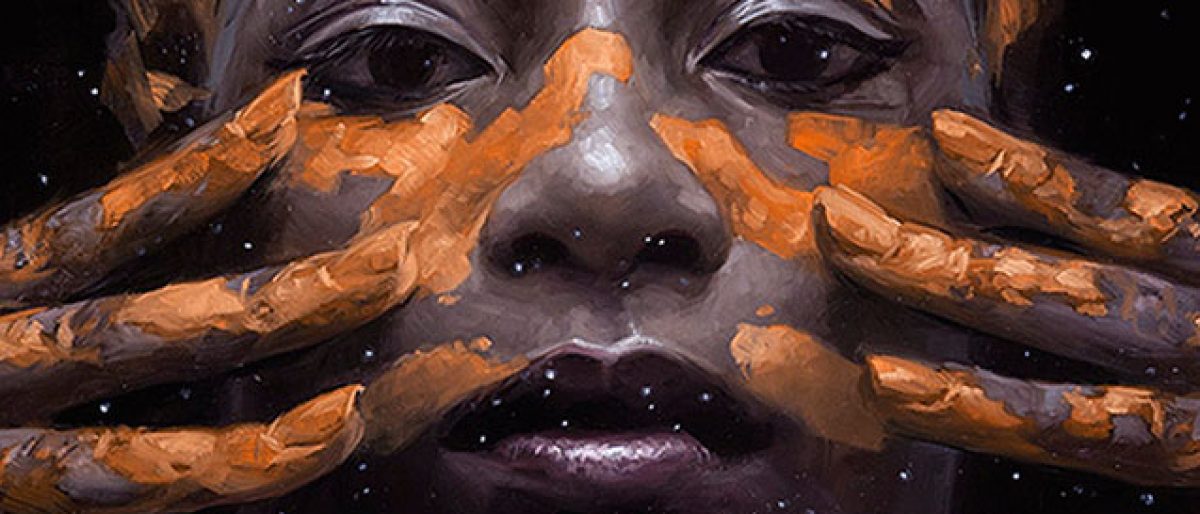
This past weekend, after a family event in Montgomery, we headed west on I80. Our destination was Holy Ground Battlefield in Lowndes County, Alabama.I’m completing Catherine Coleman Flowers’ book of the same name Holy Ground. She signed the book a few months back when we shared the same space in a small church where she was speaking. The jar of red clay on the cover feels much like many I’ve gathered before… so familiar. Red clay has always stirred a soul touching blend of joy, reverence, and a recognition I can’t quite name. Anyone who knows about me knows where red clay lives in my practice. It’s the ancient voice I paint with and believe me when I say that I carry that responsibility with a reverence that’s hard to articulate.

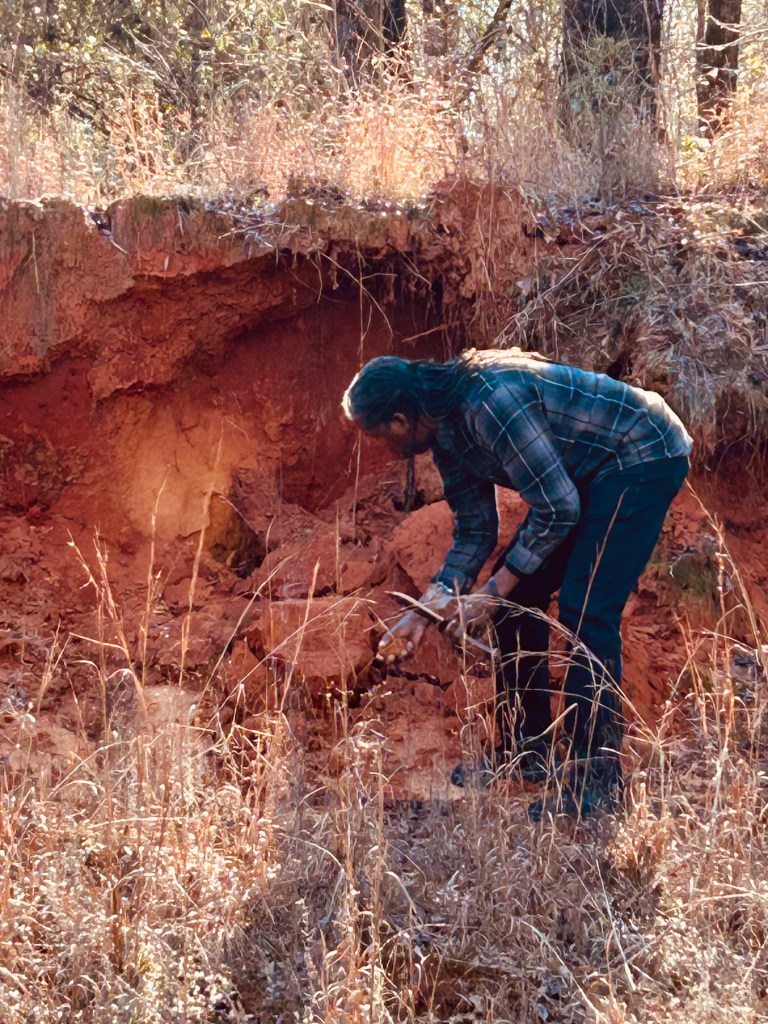
The decision to visit Holy Ground Battlefield had already been made even before we went to Montgomery. I wanted to feel the pulse of that sacred earth space for myself and to gather red clay and water from the Alabama River for a series of art pieces that have been tapping at my mindspace. Pieces that feel less like ideas and more like instructions I’ve been waiting to receive. The moment my feet touched that soil, actually as we drove into the area, there was a strong familiarity, and yet something a bit uncomfortable. It felt as though I’d been there before. There is a pulse beneath Holy Ground. Not metaphorical or imagined but an actual thrum in the earth that moves up through your soles of your feet if you’re still and quiet enough. I felt and listening. We prayed. I high fived a tree. I caressed the soil and let that red clay pour through my fingers. Then I gathered what I needed with gratitude because red clay isn’t something you just take. It’s something you’re allowed to work with. It is rich with the blood of our ancestors, and I never forget that.

In this moment in time when our political world feels jagged, abrasive, and yes, bloody, the earth beneath us still moans with an ancient steadiness. She keeps mothering us, quiet-like and patient, no matter how much noise we make on her surface. Every so often she’ll nudge us with a storm or natural attention getter. Standing on that hallowed land reminded me of something essential: beneath all of our noise, the earth still hums. She hums like a mother who has seen a thousand storms and knows this one will pass. She hums because life runs deeper and higher than whatever headline we’re distracted by. She hums because she remembers who we are, even when we forget. Red clay, for me, is part of that remembering. It holds the trace of every foot that has ever pressed into it, barefoot or booted, every struggle, every prayer, every moment of resistance and rebirth. I dance with its resiliency and it constantly speaks to me. Painting with it is painting with history, with blood, with echo, with the marrow of the land itself. It’s not just a pigment, its presence.

And as I walked back to the car with that red clay and river water tucked inside, I am renewed in a baptismal kind of way.What I do with this red clay isn’t just painting; it’s invocation. It’s listening to what the land remembers and allowing that memory to move through my hands. It’s transforming earth back into story. The pigment becomes portal. It’s granting me access to a lineage older than any of us, and honoring the unseen forces that rise when the material world is treated with respect. This work is my way of staying in conversation with the ancestors and the landscape that shaped them. It’s also my way of reaching down through time to those who will come after. It’s my form of alchemy, turning raw soil into embodiment and testimony. It’s animism in the truest sense, recognizing that the blood, sweat, and tear-rich clay is alive, aware, carrying intention of its own. I don’t force it; I flow with it. The art pieces that come from Holy Ground will carry much more than color. They’ll carry pulse and presence. They’ll carry the truth that the earth is not just beneath us, but with us. I am honored to be its translator.

I left Holy Ground, but I can still feel that pulse ringing in me. It will make its way into the work, into the surface and textures and forms that are waiting. Perhaps that’s the quiet gift red clay keeps offering: the reminder that we are always standing on more than ground. We are standing on the accumulated spirit of those who came before and the unwavering patience of the earth that carries us all. In remembrance of this and standing up to our full height measured in humanity, not inches, every step we take can be holy ground.
More Than a Portrait

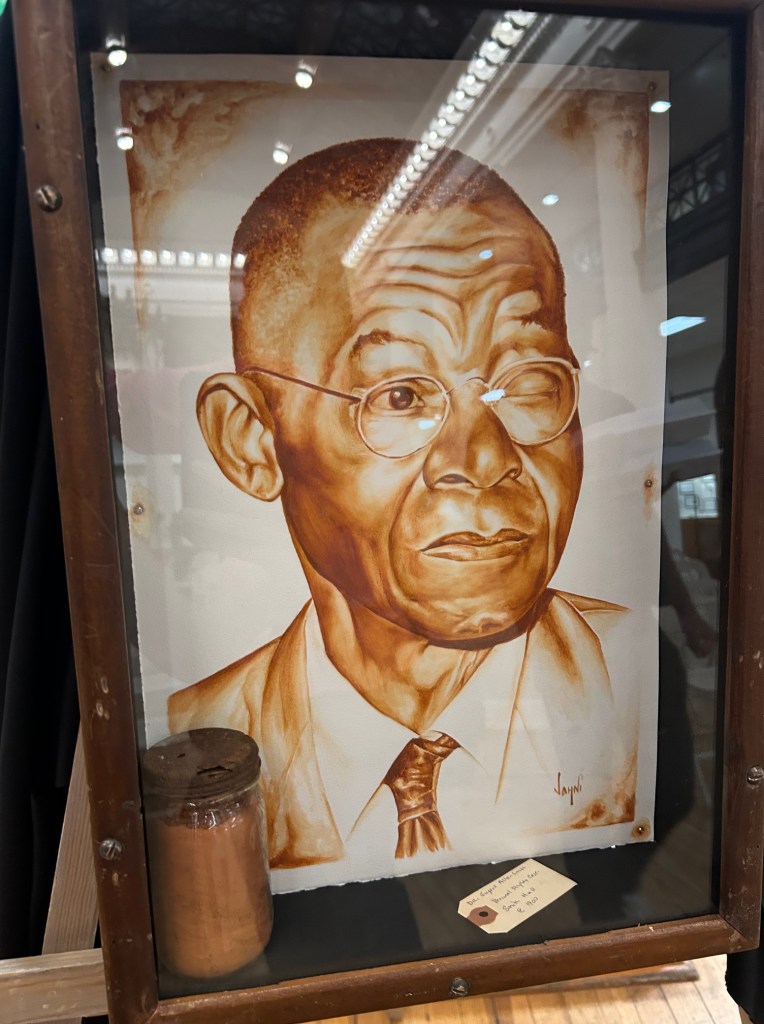
It was more than an honor to play a part in the resurrection of Jefferson Davis Jackson’s image and legacy. From the very first mention of this project, I sensed it was more than an artistic endeavor — it was a cosmic assignment, a sacred agreement between the seen and unseen, calling forth the spirit of a great man long buried beneath the weight of history’s silence. For 66 years beginning in the late 1800s, Jefferson Davis Jackson worked on the University of Alabama campus beginning at the tender age of 11 years old. Many of those years he labored alongside Dr. Eugene A. Smith, a professor and geologist invested in finding the natural resources that could be used to develop industry in the state following the ravages of the civil war. Jefferson Davis Jackson, a man devoted to life, wore many hats on campus and abroad. From custodial, to maintenance, to traveling by horse and buggy with Dr. Smith across the entirety of Alabama excavating and documenting the natural resources and history of the state.  From home to church, to work, he was all in. He worked in the very building, Smith Hall, where Autherine Lucy, the University of Alabama’s first Black student took classes. Was he there the day a shotgun blast blew a permanent scar to the outside of Smith Hall, or the day an Alabama governor made a diabolical declaration.  Somewhere along the way the name and legacy of J. D. Jackson were covered over by time, ignorance, and the order of the day. 

One day I received an email from a young woman working in the Museum of Natural science at the University of Alabama. It’s Alabama’s oldest natural science museum. I could feel the excitement through her appeal.  She had found a trail leading to the greatness of a Black man Named Jefferson Davis Jackson. She wanted me to do a red clay portrait of him. “I knew I had to contact you.” she said. “I knew you were the only one who could do this justice.”  Soon we spoke by phone and, feeling the tug of ancestral beckoning through my busy schedule, I agreed to do the portrait. I needed to walk the areas he walked, see the spaces he inhabited, speak to relatives, and gather earth from his walked pathways. Why did he start working at the university at age 11? How did he lose his eye? We scheduled a trip to Tuscaloosa and the journey began.

The process itself is ritual. I gathered red clay from the very soil of the campus of the University of Alabama. This time under the click of cameras and the gaze of assistants. The sacred ground is alive with memory, connecting my work to the land and its complex, often untold, narratives. The red clay, stained with the life-blood of our ancestors, holds within it both trauma and triumph — the iron-rich soil echoing the iron in human blood, linking us inextricably to those who came before. In its crimson grains, I feel the pulse of generations. Mother Earth knows their names. The clay is a portal, a living map. To this I added water from the nearby Warrior River. Water represents spirit. The river is a witness, a keeper of stories, a carrier of forgotten songs. Its waters hold the essence of what was lost and what still lingers. As clay and water met paper, each touch was more than technique. It was an invocation. The act of placing clay upon the surface became a merging of worlds, a thin place where past, present, and future blurred. I never work alone. Sometimes I feel like the ancestors are leaning in, guiding my hands, speaking through the vibration of the red earth. In this work Jefferson Davis Jackson was not just being rendered, but reawakened, his light called forth through the elements of earth and water, through the breath of spirit and artistic calling. 

The portrait is a vessel — a bridge between dust and flesh, blood and starlight, past and future. The red clay tethers this work to this southern landscape and to the heavens. It affirms what we already know deep in our bones: that our stories cannot be erased. They may sleep beneath the soil, but they rise again through us, with us radiant and undeniable. In this artwork, Jackson stands not as a rendering or shadow of the past but as a resurrected star in the firmament of Black excellence, human nobility, a beacon for those yet to come. From his devotion to the university and his community to his baritone voice in the church choir, he was a man among men. This is not simply a painting—it is a ceremony. A cosmic reckoning. A testimony inscribed in earth and water, blood and memory. It is a conjuring, a return, a restoration. With hands deep in sacred soil, I summon legacy back into the light, returning one of our own to his rightful place among the honored. Let this work stand not only as tribute but as threshold. A portal. A vow. To this end—and this radiant beginning—there is more to come…