A Call To Action

A month or so ago, I left a couple of pairs of shoes outside my studio. They were still in good condition butI knew I didn’t really need them anymore. I’ve cultivated the habit of passing along items I don’t use much—things I think might benefit someone else more—whether it’s clothing, shoes, or other belongings that could have a more useful life. I refer to it as blessing someone else with it. So, I marked the shoes “Free to You” and set them out for anyone who might need them.

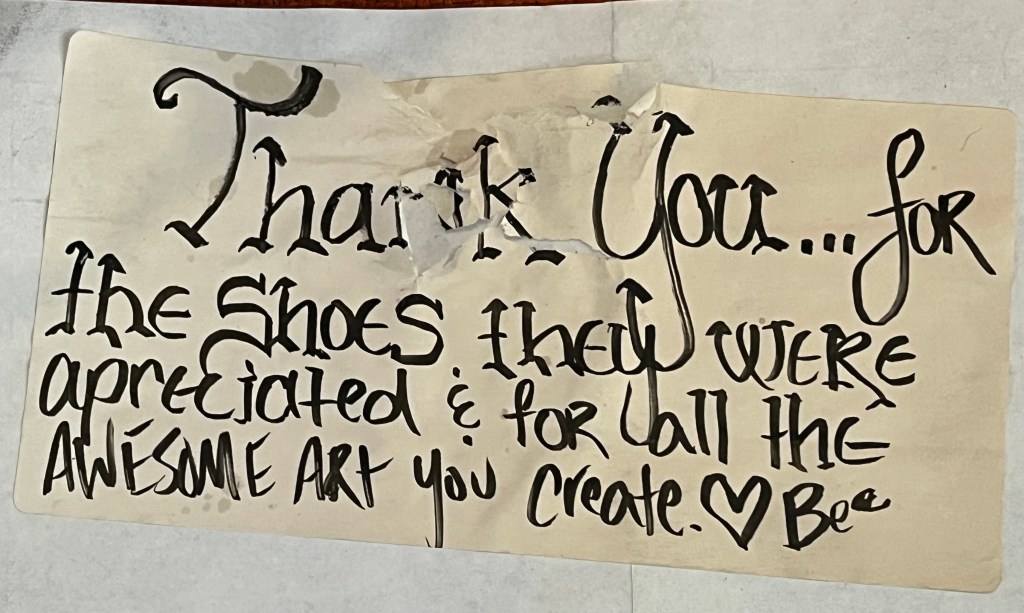
The next day there was a note on my door. It was short, but it carried with it a weight of gratitude and recognition that gripped my heart. It was a reminder of the deeper impact we can have on others, often in ways we don’t even anticipate. And I must mention, it was beautifully written.

Truly, I was moved by the thank you the shoes. That they were needed, and that the person who received them was grateful. But what hit me even harder was the second part: the recognition of and gratitude for my art . I have no idea where they may have seen my work – on the news, in a magazine, or a local mural. Either way, it had touched them. In the midst of what appears to be a struggle—of living without a home—this person could still see the value of what I create. In their own way they were affirming that my work matters, that it reaches beyond just an audience of people who walk through my studio doors, gather in suits and dresses in hallowed halls, and touches unexpected lives in unexpected ways. In that moment, I was reminded of the unique power of art. We often talk about art as something that reflects society or speaks to our times, but I also know art has the ability to transform us, to bridge divides and transcend barriers. To speak to the human condition, in whatever form it may take.

For this person, my art practice is not a distant or abstract concept. It wasn’t just something I put on a canvas or created in my studio. My art was seen, appreciated, and connected to an act of kindness—a simple gesture of sharing something as basic as shoes. They had, in turn, extended a gesture of kindness back, not just in thanking me, but in acknowledging the value of what I do as an artist. This experience has made me think a lot about how we can all intentionally contribute to the world, in big and small ways. Whether it’s through a work of art, a service rendered, a loaf or bread baked or bought, a pair of shoes, or a kind word, we all have the power to make a difference. And sometimes, it’s the smallest gestures that have the most profound impact.

We live in a world where it can often feel overwhelming to think about how we can truly make impact. But it takes every stroke to make the masterpiece. If you have things you no longer need or use consistently, consider blessing someone else with it. It could be something as basic as shoes, clothes, food, or even a bit of your time. And, for creatives, it’s a reminder that what we create has value far beyond the walls of our studios, labs, workshops, or galleries. Our work can touch lives in ways we may never fully understand. Creativity is a powerful tool for connection, and sometimes, it’s the unspoken messages that resonate the most. Let’s remember that what we give—whether it’s material goods or the fruits of our creativity—can make someone’s day, or even extend a life, reminding them they matter, lifting their spirits when they least expect it. So, the next time you come across something that could be useful to someone else, or you feel compelled to share a piece of your heart through your art, go for it. Bless someone with it. In the blessing you are blessed. You never know what impact your act of kindness might have, or how it might be received by someone who needs it most.

Thank you to the person who left that note. You reminded me of why I do what I do. And to everyone reading this: take a moment today to pass along something you can part with. It may be of much more value to someone else. You just might touch a life in ways you never imagined. Bless someone. I dare you…

UNBROKEN PARADOX

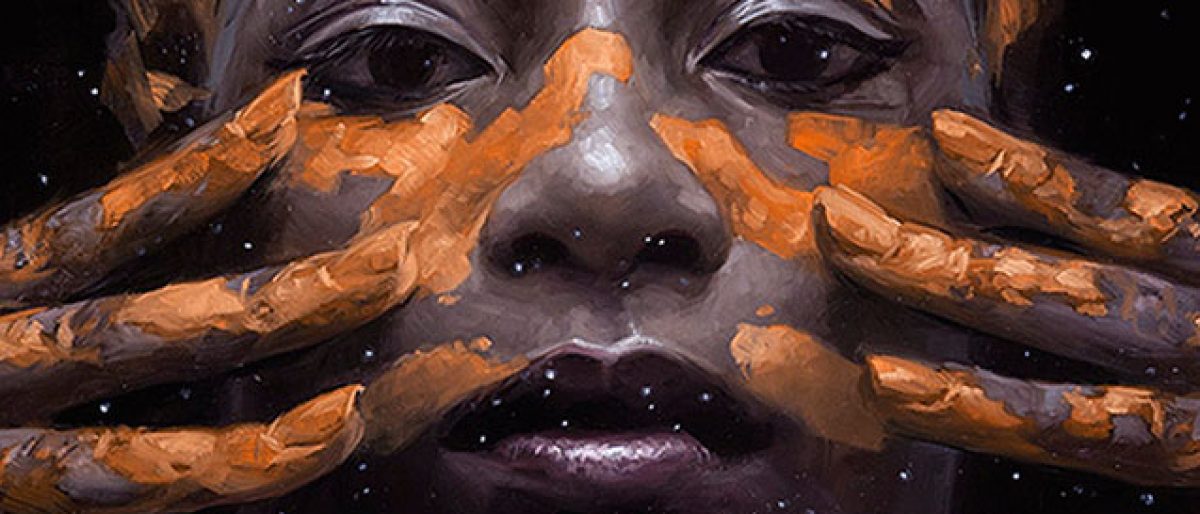
I am taking a departure from my normal and sharing a work of visual art. “Unbroken Paradox” honors the extraordinary life of William Hooper Councill, a former enslaved man among men who rose from the red dust of Alabama to become the founder and first president of what is now Alabama A&M University. This work, created with red clay taken from the grounds of his enslavement and the university he built, embodies the profound duality of his journey—pain and triumph, oppression and liberation, roots and ascension.

I was told by a professor while an undergrad at Alabama A&M University that “Your success is inevitable because this Alabama Red Clay is rich with the blood of your ancestors.” Those words transformed me from a witness to a man on and in purpose.  The red clay is more than a medium; it is history itself, rich with the essence of the land that bore witness to Councill’s transformation. From the soil of hardship grew a legacy of excellence, a paradox of unbroken spirit in the face of unimaginable adversity. This work connects past struggles to present victories, serving as a timeless reminder that greatness can emerge from even the harshest conditions.

“Unbroken Paradox” is a piece of history that celebrates the resilience, vision, and courage of one of Alabama’s greatest pioneers. It’s a testament to the power of education to uplift and transform lives, just as Councill did for countless others. This work is charged with the “blood” of our ancestors. “Unbroken Paradox” is not merely a painting; it is a legacy, a story of perseverance, and a beacon of inspiration for generations to come.

Standing In The Night

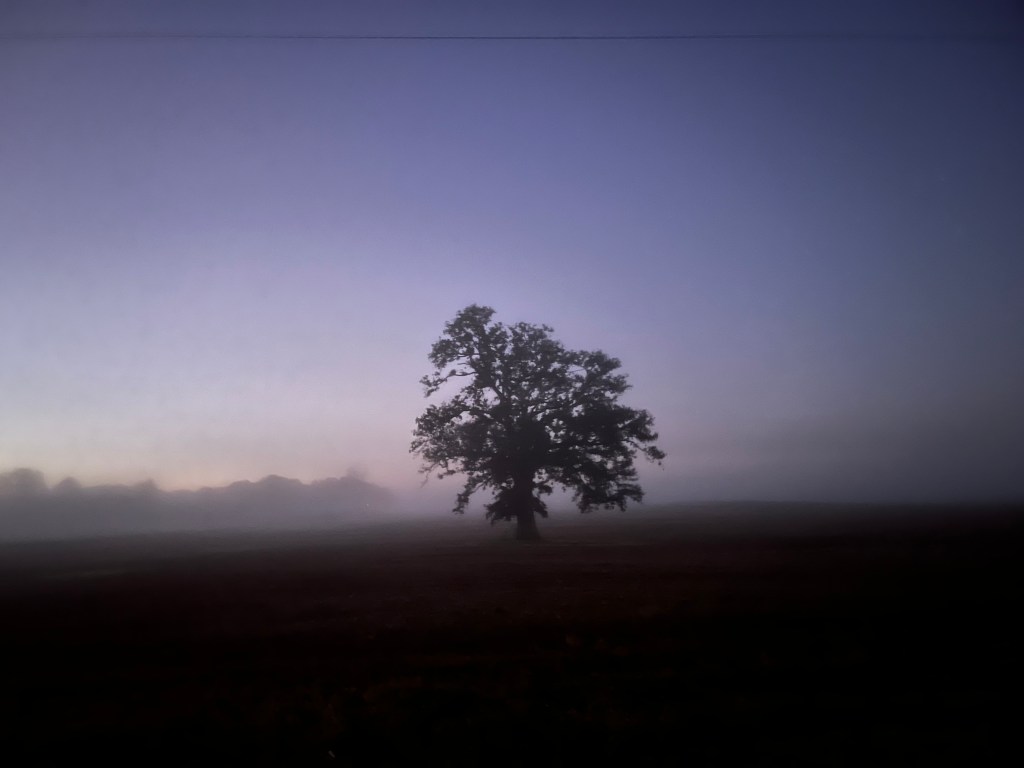
The other night as I made my sojourn home after what seemed like hours in traffic, I saw this lone oak tree out in the field. I’ve seen this tree standing there at that turn through every season year after year. It’s been the focus many photos . This particular night, however, it seemed to possess a different power. I felt like it was speaking directly to me about the Power of standing. Not just standing when you have all your ducks in a row or you think you’re at your best but standing just as tall under the cloak of darkness. Life often brings moments that feel like long nights—when the darkness seems overwhelming, and the weight of our struggles eclipses the light of our creative spirit. For those of us with unconventional careers—artists, writers, innovators—these nights can feel particularly heavy. Especially since we’re already navigating uncharted waters, relying on our passion, plans, and fortitude to stay afloat.

Recently, I was reminded of this when a dear friend, someone I consider a sister, faced the unimaginable loss of both her parents within a short time. These were people who not only shaped her life but also touched mine. They were pillars, guiding lights whose love and wisdom made the world feel more steady. In their absence, she could have crumbled under the weight of grief. But instead, I saw her stand—tall, unwavering, and deeply rooted in her truth. Her smile became the sunshine, the glow in dark times.

Watching her navigate this profound loss, I was struck by her resilience. She reminded me that standing in the night is not about denying the darkness. It’s about acknowledging it while refusing to let it extinguish your light. As creatives, we often find ourselves in similar moments. The rejection, the self-doubt, the financial uncertainty—they can all conspire to pull us into the shadows and choke out the power of our craft.

But here’s the lesson: the night is not the end. It’s a canvas. In those moments of darkness, you have a choice. You can retreat, or you can create. You can let the night silence you, or you can let it inspire you to speak louder. My friend chose to stand in her power, honoring her parents’ legacy by continuing to live fully, to love deeply, and to create meaning from her pain. For those of us pursuing paths that require risk, courage and creativity, we must do the same. We have to stand in the night. We have to create in spite of it—or perhaps because of it. Our art, our work, our very lives are testimonies to the fact that the night cannot last forever. Moreover, You’re never really alone, no matter how solitary you feel. You are rooted in the dreams and hopes of the ancestors, planted in this earth.

Remember that stars shine brightest in the darkest skies. So, when life feels heavy, remember this: your power and connection doesn’t vanish with the setting sun. It becomes a beacon, guiding you and others through the night. Stand tall. Stand firm. Stand in the night. And know that your light, no matter how dim it may feel, has the power to guide you home while illuminating the path for someone else. Keep creating. Keep believing. Keep standing.

Doing Your pART

Around 2:30am my time, I received a message from a fellow artist on his way to Kiev (Kyiv), capital of Ukraine. His urgent request for my assistance brought to mind the role of the artist rooted in the charge of the incomparable Paul Robeson…

“Every artist, every scientist, must decide now where he stands. He has no alternative. There is no standing above the conflict on Olympian heights. There are no impartial observers. Through the destruction, in certain countries, of the greatest of man’s literary heritage, through the propagation of false ideas of racial and national superiority, the artist, the scientist, the writer is challenged. The struggle invades the formerly cloistered halls of our universities and other seats of learning. The battlefront is everywhere. There is no sheltered rear.

To make a living is not enough. There is a dire need to make spaces fit for life itself, at home and abroad. Now, perhaps more than ever before, the work of the artist, the maker, the creative, is needed. Art has the power to move the cosmic needle. With that power comes a responsibility – a responsibility we can shoulder or shove away. The right to choose remains … for now. Let us move as we are moved. Each creative get to make a conscious effort on that decision for her or himself. Art is an action word.

Sight

In a meadow full in bloom with the palette of Autumn tones

Of browns, reds. yellows, burnt oranges, and gold

A man came running though

Fast, straight through he came

Dodging branches of low hanging trees

Over the leaves and across the creek 

But not a color he did feel

He was on the run you see, for committing a robbery

On he ran through the palette of Autumn tones

Past browns, reds, yellows, burnt oranges, and gold

In a flash he was gone.

Into a meadow full in bloom with the palette of Autumn tones

Of browns, reds, yellows, burnt oranges, and gold

Came a child bright with life and surely just as bold

Poor in goods and material things

her legs twisted and small

She gasped with open eyes and a wide mouth smile

As she gazed to the painted trees that stood so straight and tall

She took it all in again and again

And spun around in circles big

Dancing in the wind

To the rustle of the autumn leaves

And the sound of the flowing creek

And had not noticed the piles of money swirling at her feet.

The Art of Letting Grow

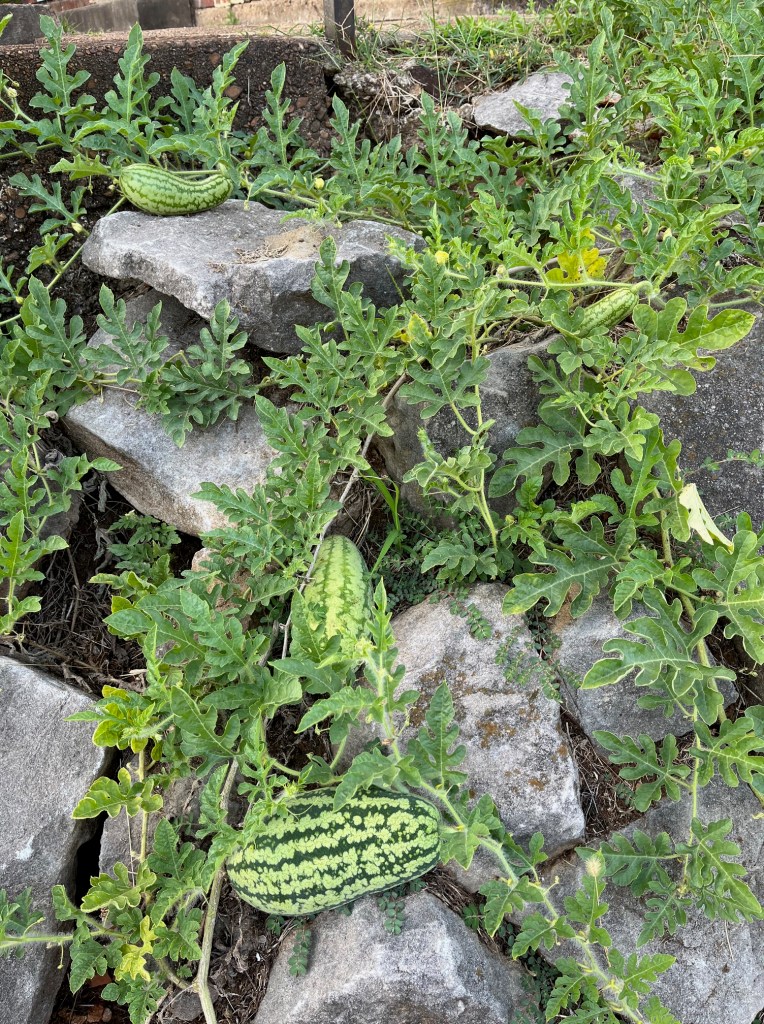
My studio is located in a transitioning neighborhood. With that come people who are transitioning – with some of them currently unhoused. I planted watermelons on the rocky terrace out front. Miraculously they grew like crazy. The fruit thrived in my alternative urban rock-strewn garden. I saw the project as an extension of what I do as an artist. This was both an installation and performance art. I would see people passing by and taking photos of the strange combination of watermelons and the wide open eyes that I had painted onto some of the rocks.

One of the purposes aside from my love of growing things was to have something to share with the neighborhood. Something organic in more ways than one. At the end of the visual feast there could be an actual one. As the succulent fruit began to mature, I started noticing that they also began their departure. Day by day I saw the watermelon patch grow a little more patchy. The neighborhood definitely understood the assignment. I took a sense of satisfaction and joy in the dual nature of my “project”.

Finally, there was one small melon left. A friend told me that if I wanted one I better go ahead and get it. Many had expressed their dismay that I didn’t get the opportunity to enjoy the fruit of my labor – that all of the melons had been stolen. I didn’t see it that way. I felt no anger or sense of violation. I think inherent in a creative person’s nature is to share. This may have negative consequences at times but our creative reserve is also heavily equipped for recovery. Sure it would have been nice to try one of the melons but the overall intention was coming to pass.

One evening, as I left, I eyed the last little melon tucked close to the steps. It did not look ripe at all but I knew if I didn’t get it, I wouldn’t have one at all. Putting my things in the car, I walked back over and plucked the little fella from its bed. When I got home, I gave it to my daughter to play with. She wrapped the little mellon a blanket and babied it for about a week.

One morning she came down with it and put it on the counter in the kitchen as she passed by. “I wonder if that thing is any good.” I said out loud. “You want to see? Her answer surprised me. I definitely thought she would be sentimental about it. A little while later we had a bowl full of deep red fully ripe-looking fruit. She volunteered to be the guinea pig. I let her without hesitation. Her first bite told me it was better than I thought it would be. I took a bite. It was ridiculously delicious. We almost ate the entire bowl but stopped ourselves to save some for the rest of the family.

I’d assumed the melon wouldn’t be ripe because of its size and since it had been carried around for a week or so. I was wrong on both accounts. That little melon carried a wealth of lessons. This whole thing showed me the benefit of sometimes letting go of ownership to embrace shared joy and community. Rather than feeling the need to guard what I grew, I saw the plants as art and a gift to the neighborhood. Generosity is its own reward. When the last melon, babied for a week, unexpectedly ripe and delicious was enjoyed together with my family, it served as a reminder that good things come not only from control but also from surrender. This experience tied the harmony between creating and sharing. Art is life and life is art, especially in moments when we allow others to fully partake in what we’ve cultivated.

Sabbath

Just over a year ago, I resolved to honor myself through, by, and for the work I do. Yes, I recognize that the work is the path to purpose, the production. However, there is no production without a producer. Therefore honoring myself with adequate rest and rejuvenation became more of a priority. I admit, however, with my imagination output and the resulting schedule, it’s been no easy task. It’s easy for me to run my body at breathtaking speeds and relentless productivity levels, simply because it will. I also know that it is not sustainable. At some point the piper must be paid.

As a child, I grew up in an ultraconservative religious household. Each week beginning on Thursday afternoons, we began preparation for the Sabbath. I recall one of my task was to use mayonnaise to clean and gloss the plant leaves. That, I did with tenderness and pride, leaving the leaves shiny and radiant. We shined the silver, did the dishes, ironed clothes, and Mom prepared the largest meal of the week all in preparation for our time of rest. By sunset Friday a calming hush had come to our humble abode. For the next 24 hours we were immersed in restfulness, reading, nature, communion, and religious services. The sabbath would be closed out with song, “day is dying in the west, heaven is touching earth with rest…” We recognized the sabbath as the seventh day of the week as noted in the Torah in the book of Exodus, verses 8-11. From a little tot on up, each week we would recite the verses beginning with “Remember the sabbath day, to keep it holy.”

The ultimate reason for the sabbath was rest. No just a casual rest but a deep abiding, reconnecting rest that would bring healing from the week and prepare us to meet the week to come.”Six days, it says we have to do all of our work but the seventh day, a day of rest, belongs to the divine, to rejuvenate and recreate us as sound human beings to maintain the embodiment of that divine. Otherwise we find ourselves depleted, scattered an mind, body, and spirit, operating in a capacity far lower than our capabilities. This weakened state affects us in every aspect of our existence from our individual health to our relationships. Yet we continue to push, push, push, until we crash. We consistently circumvent our internal preservation mechanisms, crying desperately for the slow down, by drowning it out with artificial adrenaline we call caffeine. Eventually, as I stated earlier, the piper will be paid.

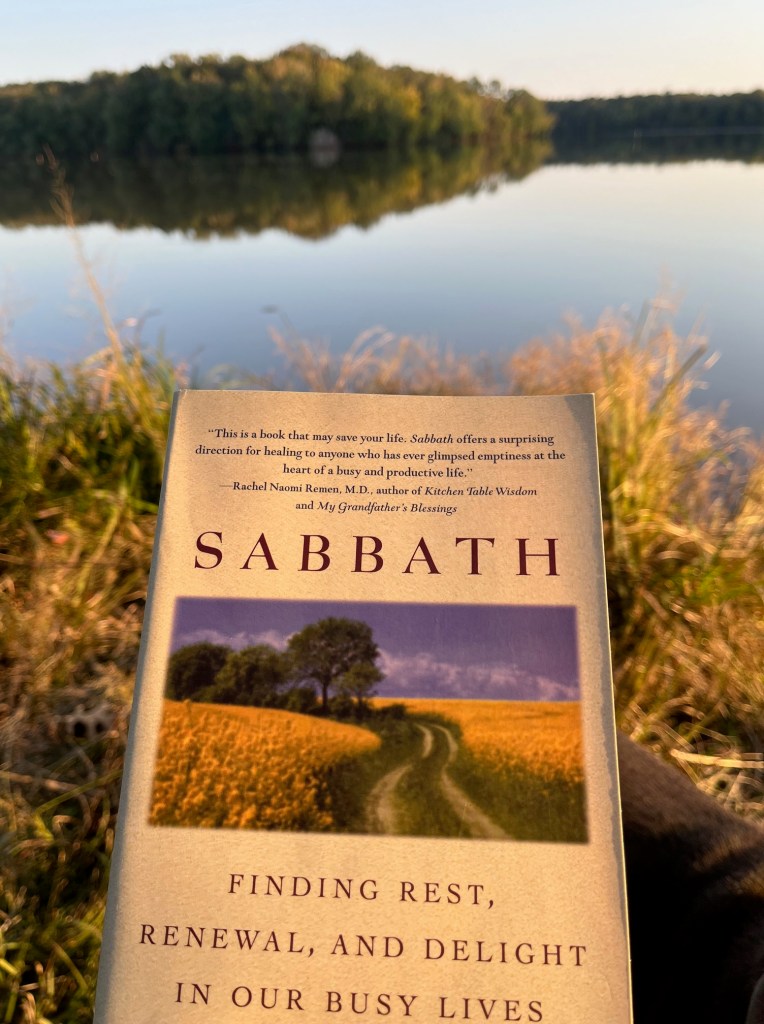
A few weeks ago, I picked up a book entitled Sabbath, by Wayne Muller. The understated cover of the paperback book reached out to me from the shelf. It felt soothing in my hands with it’s earthy colors woodland imagery. It’s subtitled Finding Rest, Renewal, and Delight In Our Busy Lives. For me it was a much needed reminder to reincorporate the joy and balance of the Sabbath in my life. The verse admonishes us to remember the sabbath, as though it was known that we would be prone to forget it. The sabbath is for everyone. We can start by designating specific times each week for rest and reflection. This sacred time can be marked by personal rituals—like lighting a candle or spending time in nature—to signal a transition into relaxation. Disconnecting from screens and social media during these hours allows for true rejuvenation, while engaging in meaningful activities—reading, hiking, or connecting with loved ones—nurtures our spirit. Incorporating mindfulness practices can deepen our presence, and sharing this time with family or friends fosters community and connection. Reflecting through journaling can also provide clarity and purpose. By intentionally embracing these practices, or different ones that serve you, we can reclaim the essence of the Sabbath, fostering a deeper life beyond the rat race pace that goes beyond mere existence and invites of to be a pART of the remedy toward healing our rest deprived world.

Curating Spaces

Curation is about much more than hanging art on walls or items in a collection—it’s about shaping environments that reflect our values, histories, and aspirations. As an artist, I recently completed a commission for the new City Hall, an institution of governance and civic pride. Yet, directly across the street, the basement of a former bank holds a darker legacy: it once imprisoned enslaved people, treating them as chattel collateral in its cold stony bowels. This stark contrast between spaces reminds us how intricately intertwined the present is with the past, and how our relationship with space has the power to elevate or diminish our humanity.

We are the curators of the spaces we inhabit—our homes, workplaces, public buildings, and the invisible spaces between us as human beings. For too long, access to these spaces, particularly those of influence and power, was denied to people based on race, class, or gender. Today, as we step into places where chosen sectors of society were forbidden, we carry a responsibility to reimagine and reshape them with intentionality. Whether we are conscious of it or not, we design the spaces that define us, deciding who gets to be seen, heard, and respected within them.

Curating space goes beyond physical walls; it’s also about the various interactions that shape our societies. How we treat one another in these spaces, the stories we honor, and the legacies we confront are all part of this curation. Just as we, as artists, choose what to display in a gallery, we choose what to elevate or omit in our life space as well. Spaces, after all, are more than just physical—they are emotional and symbolic. They carry the not so dead weight of history but also the potential for resurrection and transformation.

Today, as we gain access to spaces once closed to some by law, litany, or self-imposed limitation, we do so with the knowledge that we are responsible for more than just being there. We must curate them for ourselves and future generations, ensuring that the injustices of the past do not persist and walk among us in contemporary designer hoods. Every room we enter, every relationship we foster, and every piece of art we create becomes a part of that narrative—a reflection of how we choose to inhabit the world and bridge the spaces between us. The question is not just how we fill these spaces, but how we use them to uplift and honor those who came before, while making room for those yet to come.

Remember Who You Are

It has that thing – the imagination, and the feeling of happy excitement – I knew when I was a kid.” Walt Disney

Aside from love, imagination may be the most powerful force in the universe. As powerful as it is, it’s abundant and unfettered in the most vulnerable beings on the planet- children.

As an art educator, I used to admonish educators and students to remember who you were before you were told what to be. We are filled to the brim with imagination as children. As we grow up, however, that imagination dwindles until we become cookie cutter beings plugged into the machine on the level of existing to fill a space like another brick in the wall (shoutout to Pink Floyd).

For as long as I can remember, imagination has been my favorite word. As “artist ” became my profession of choice, I took comfort in claiming the word imagination, feeling I was an authority on the subject. All the way up until I realized that I too had gotten caught up in the turning of the wheel, working hard to make a living while refusing to fully dance with the joy and mysteries of life fed by the power of imagination. It was out of a misguided sense of responsibility, resisting the frolic of the mind reaching into the light of life and tasing all the good parts. I had drifted into the void and lost touch with the quintessential child inside.

My youngest daughter, still very much connected, continuously reaches into the imaginal abyss, with her seemingly absurd questions and “what if” scenarios. Her relentless roving mind never let up on tap tap tapping on my spirit’s door until I could finally hear what she was waking me up to. Her vivid imagination has become the spark that is rekindling my own imagination and awakening, reassembling my inner artist/child; over the too serious role (hole, box) I find myself slipping into. Her boundless creativity is a north star in my liberation journey. I now intentionally listen to her, deepening my own artistic awakening, remembering who I am. This re-membering is a little deeper than the idea of recall. It is the tedious and life giving act of putting back together the parts of ourselves disassembled by the destructive nature of a survival mentality.

I would be willing to bet there is something calling you. You feel it. You hear it. You even catch glimpses of it. It shows up in the strangest or most common places, like some consistent voice in the wilderness crying out to you. I was watching a movie the other night. There was a note in the film that read, “Remember who you are.” In that moment I knew that I was refusing to acknowledge what I already knew. Even after the movie, I could not shake the words. That night I had a vivid dream that opened up a sense of possibility that I had not felt in a while. A space that was both familiar and brand new at the same time. A space, where limits are pushed off the outer edges of life’s surface. A space that is safe for remembering who I am.

Same Sun

My oldest daughter was born in Crozer-Chester Medical Center in Chester, PA. Those hallowed grounds were once occupied by the Crozer Theological Seminary attended by such notables as J. Pious Barber, Samuel Dewitt Proctor and Dr. Martin Luther King, Jr. These were giants of men, men of faith I hold in high regard. I often walked these grounds where they walked in honor, remembrance, and reflection.  

We had relocated to Pennsylvania on faith in what I do as an artist to start a new life. We named our daughter Imani, which means faith with Arabic and Swahili origins in East Africa, as a testament to that move. This year Imani returned from Alaska, another faith move – there and back. At the morning of this writing, she is on a beach in Maryland, as I am in one of my favorite places on the planet, Chicago.  We exchanged sunrise images. The one thing constant in them both is the glow of the morning sun. Faith is the knowing that the sun will always rise. No matter how dark the night or tumultuous the storm, that golden orb ascends to the heavens as a metaphoric reminder. A reminder that we can always begin again, and that success came before us on the same planet that we walk. Sometimes even the same ground that we walk over. Remembering and thinking on things like this can help to put things in perspective as we go about the tasks involved in doing what we do.

Think of your most revered luminary. In this case allow it to be someone that you admire in your field of choice. Someone who has made accomplishments in the area of which you aspire to succeed. See them in action in your mind going about their tasks from the mundane to the magnificent. Above them every day is the same sun that shines down on you. The setting of your story has the same lighting as theirs. The warmth, the light, the brilliance — all of it bathed their path just as it bathes yours. The same source of energy that sustained their journey is sustaining you now, fueling your own rise, your own breakthroughs.

It’s easy to look at those who’ve gone before us and imagine that they had some secret, some hidden resource, but the truth is they moved forward in the same rhythm of faith, resilience, and consistency. Like the sun, they showed up, even on cloudy days when success seemed distant. And just like the sun, their brilliance was a reflection of what already existed inside them.

Faith, like the light of the sun, is a force we often take for granted, yet it’s always with us. Just as we trust that the sun will rise each morning, we must trust that our own light, our own success, will also emerge — even when it’s not immediately visible. Even on those days when we whisper in quiet desperation,”What the hell am I doing?”

Imani, faith, is not just the name of my daughter; it’s the principle that guides the journey. It’s in the small actions, the steady discipline, and the unwavering belief that, just like the sun, the time will come to rise higher. No storm, no night, can prevent the dawning of your potential. So as we stand on this shared ground, beneath this shared sun, know that you’re already on the path — step by step, light by light, day by day, moment by moment — to becoming the luminary that will shine for the generations to come.